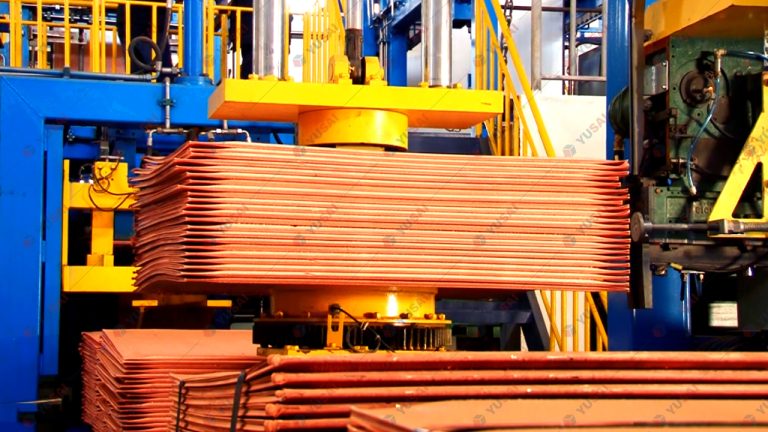
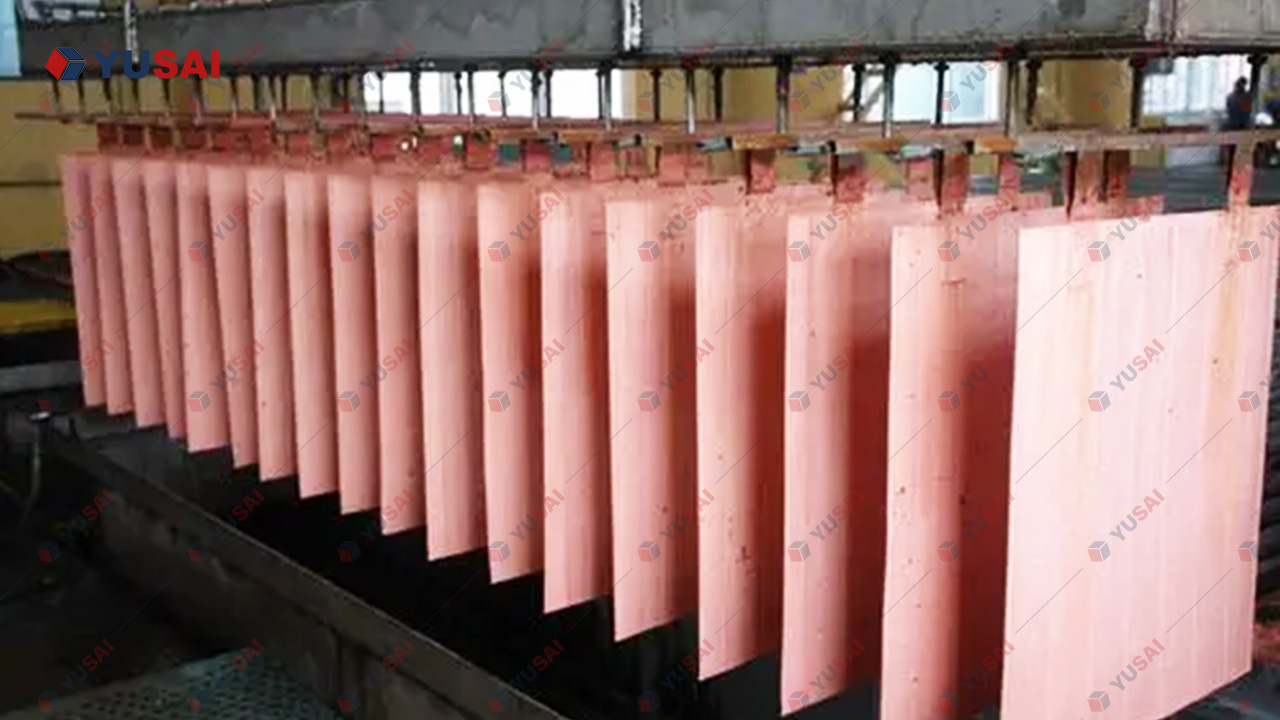
The permanent cathode electrolysis method is a copper electrowinning process developed by the Townsville Refinery in Australia in 1978. Its core feature is the replacement of traditional starting sheets with reusable stainless steel mother plates; cathode copper is stripped from the mother plates by an automated stripping machine (typically after a 12-day electrolysis cycle), and the mother plates are treated and recycled into the process. The permanent cathode plates are made of 316L stainless steel, while the conductive bars consist of 304L stainless steel plated with copper. Supporting equipment includes anode processing units and scrap anode washing units. Productivity is enhanced by reducing inter-electrode spacing and increasing current density; electrolytic copper produced via this method now accounts for 30% of global total production.
Introduction to the Permanent Cathode Electrolysis Method
Developed and implemented by the Townsville Refinery in Australia in 1978, the permanent cathode electrolysis method is characterized primarily by the use of reusable stainless steel mother plates instead of traditional starting sheets. Cathode copper products are stripped from the stainless steel mother plates by an automated machine, and the plates are treated and returned to the production system for reuse. The permanent cathode plates are made of 316L stainless steel with a thickness of approximately 3.25 mm. The conductive bars feature a hollow rectangular cross-section; they are made of 304L stainless steel pressure-welded to the 316L mother plate and plated with copper (1.3–2.5 mm thick) to ensure excellent electrical conductivity. The edges of the mother plate are encased and bonded with acrylic PVC plastic strips, and the bottom edge is coated with wax. The service life of the plates can reach up to 15 years. The process utilizes specialized equipment such as anode processing units, scrap anode washing units, cathode washing units, and dedicated cranes, offering production technical indicators that are superior to those of traditional methods.
Preparation of Starting Sheets
There are three types of starting sheets: ① those made of cathode copper, which become part of the cathode copper product after electrolysis; ② titanium plates; and ③ stainless steel plates. The latter two types are reusable and are known as “permanent cathodes.” Starting sheets for copper electrolysis are produced from pure copper sheets obtained by stripping the deposit formed after several hours of electrolysis in a cell—often called a “seed plate cell” or “mother plate cell”—that utilizes a reusable pure copper or stainless steel “mother plate” as the cathode.
1. Preparation of mother plates before insertion into the cell: Mother plates are typically made of rolled pure copper, though some plants use stainless steel or titanium plates. The surface must be flat and free of pinholes or cracks.
The dimensions of the mother plate generally exceed those of the starting sheet by 20–30 mm in width and 50–70 mm in length. To facilitate stripping, a 10–15 mm wide insulating border is applied to three edges of the plate. Additionally, a release agent is applied to the surface to prevent the deposited copper sheet from adhering too tightly; however, release agents are not required when using titanium or stainless steel mother plates.
2. Technical conditions for mother plate cells:
To ensure the deposited cathode copper is dense and of high quality, the starting sheet itself must be dense, smooth, and free of copper nodules or burrs. Consequently, compared to standard electrolysis cells, mother plate cells typically operate with slightly lower current density and wider inter-electrode spacing; additive dosages are increased, and higher electrolyte purity is maintained.
Anodes used in mother plate cells must be of high quality—specifically, they must have smooth, flat surfaces and uniform weight—to minimize electrolyte contamination by impurities and prevent inter-electrode short circuits. Anodes in these cells are replaced after only one-half to one-third of their normal service life; this prevents the active surface area from shrinking significantly (which would otherwise raise the current density) and ensures the quality of the starting sheets. Anodes removed from mother plate cells still retain sufficient thickness to be transferred to standard production cells for continued use until the end of their scheduled service cycle.
3. Processing of starting sheets:
After the mother plate is placed in the cell and electrolysis proceeds for 12–24 hours—depending on the plant’s specific mechanical processing requirements—it is removed… After removal, the copper adhering to the surface is rinsed off with warm water, and the copper sheet (often referred to as a “starting sheet” from this stage onwards) is peeled off using a flat tool. Starting sheets with smooth, defect-free surfaces are used as cathodes in the electrolytic cells, while those with nodules or defects are used as suspension bars.
Advantages
During the electrolysis process, copper deposits onto the stainless steel plate; upon completion of a cathode cycle, the copper is stripped from the stainless steel cathode, and the cathode itself is reinserted into the electrolytic cell for the next cycle. This process repeats continuously. Consequently, the starting-sheet electrolytic cells required by traditional methods are eliminated, and a single cathode washing and stripping unit replaces three separate processing lines: the starting-sheet production unit, the conductive bar storage and transport unit, and the cathode copper washing unit. The main advantages are:
1. The use of permanent stainless steel cathodes eliminates the need for starting-sheet production and the associated cathode assembly tasks, thereby simplifying the production process.
2. Permanent cathodes offer high strength, excellent flatness, and smooth surfaces, allowing for reduced inter-electrode spacing, fewer short circuits, and higher current densities. This ensures product quality while increasing cathode copper output.
3. The cathode cycle is shorter, resulting in less copper inventory and faster capital turnover.
4. The process features a high degree of mechanization and requires fewer operators. However, the use of permanent stainless steel cathodes and advanced mechanization entails a higher initial investment.