
Copper Cathode Production Line
— Turnkey Copper Cathode Production Line
The Copper Cathode Production Line is a turnkey system that converts copper anode, blister copper, copper scrap and copper-bearing solutions into 99.99% Cu copper cathode to the LME Grade A / EN 1978 Cu-CATH-1 specification. Copper electrorefining (ER) and solvent extraction–electrowinning (SX-EW) run on one permanent-cathode platform with integrated electrolyte purification and anode slime recovery. Capacity is modular and expands by adding cell banks.
- Output: copper cathode, Cu ≥ 99.99%, LME Grade A / Cu-CATH-1
- Feedstock: copper anode, blister copper, copper scrap, copper powder from PCB recycling, copper oxide ore, copper-bearing solutions
- By-products: gold, silver and platinum-group metals from anode slime; nickel salts from electrolyte purification
Product Overview
Suitable feedstock
The copper cathode production line is built around the reality of copper-bearing raw materials as they actually arrive at a plant gate — not as they appear in a textbook. On the anode route it accepts copper anode plates and blister copper with a copper content of 98% and above, together with smelted mixed purple copper, copper alloy scrap, and copper powder recovered from PCB and e-waste processing. Because recycled anode copper typically carries higher levels of arsenic, antimony, bismuth and nickel than primary anode copper, the line is engineered to tolerate that variability rather than assume clean feed. On the SX-EW route it accepts copper oxide ore, copper concentrate leach liquors, low-grade heap leach solutions, and copper-bearing spent solutions from plating and metal-finishing operations, working from copper concentrations as low as a few grams per litre.
Where the feed arrives as loose scrap, powder or molten metal rather than as a cast anode, the line is supplied with an upstream anode section: melting furnace, anode casting machine and anode preparation unit, which convert the material into dimensionally consistent anode plates ready for the cell house.
Processing technology
Copper is refined in two stages, and the difference between them decides how much of the value in the feed reaches the finished cathode.
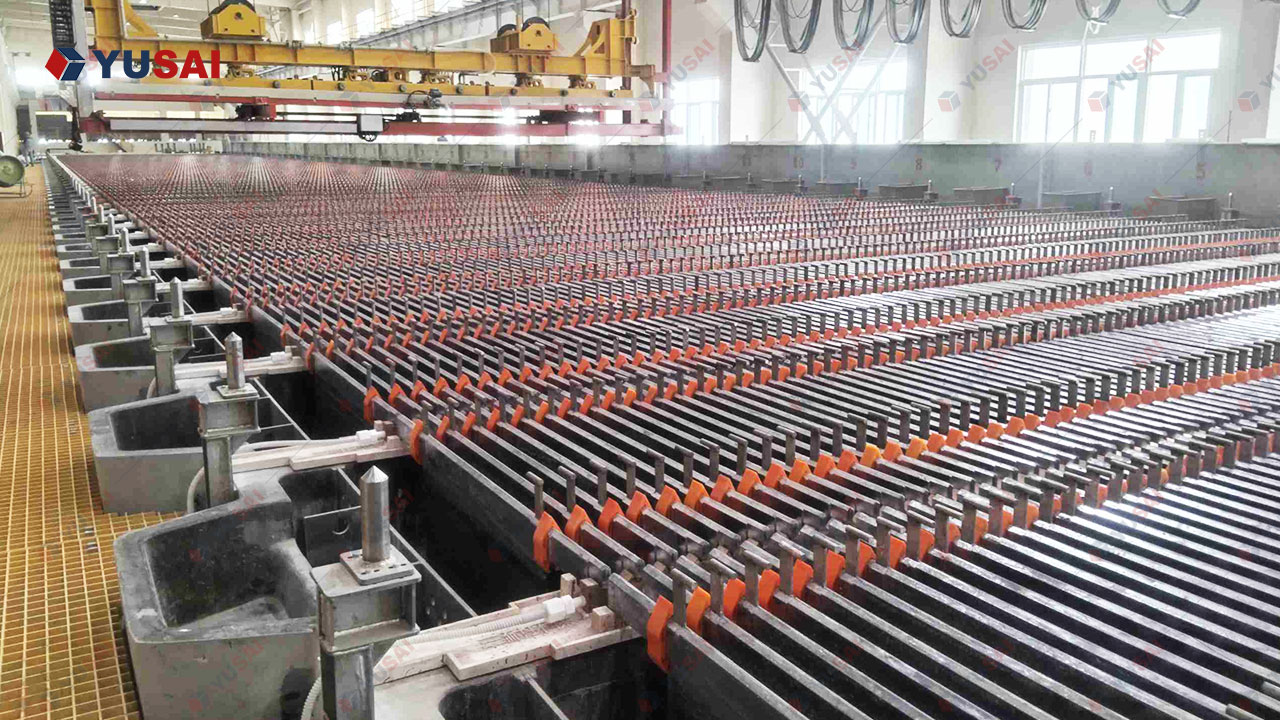
In electrorefining (ER), cast anode plates and permanent stainless steel cathodes are suspended in pairs in acid-resistant electrolytic cells filled with an H₂SO₄–CuSO₄ electrolyte. Direct current is applied across each anode–cathode pair. Copper dissolves anodically into the electrolyte as Cu²⁺, migrates through the solution, gains electrons at the cathode and deposits as dense, high-purity metal. Noble impurities — gold, silver, platinum and palladium — do not dissolve and settle to the cell bottom as anode slime. Base-metal impurities such as iron, nickel and cobalt dissolve into the electrolyte and are controlled by continuous circulation with full-volume filtration and by regular electrolyte purification, which keeps the impurity balance inside specification and lets the cathode purity hold at 99.99% over years of operation, not just in the first week.
In SX-EW, copper is first dissolved from oxide ore or copper-bearing solutions by sulphuric acid leaching, then separated and concentrated by solvent extraction using an organic extractant that selectively loads Cu²⁺ and rejects iron and other impurities. The loaded organic phase is stripped back into a clean, high-concentration electrolyte, which feeds the electrowinning cells. There, copper is deposited onto permanent stainless steel cathodes under the same principle as electrorefining.
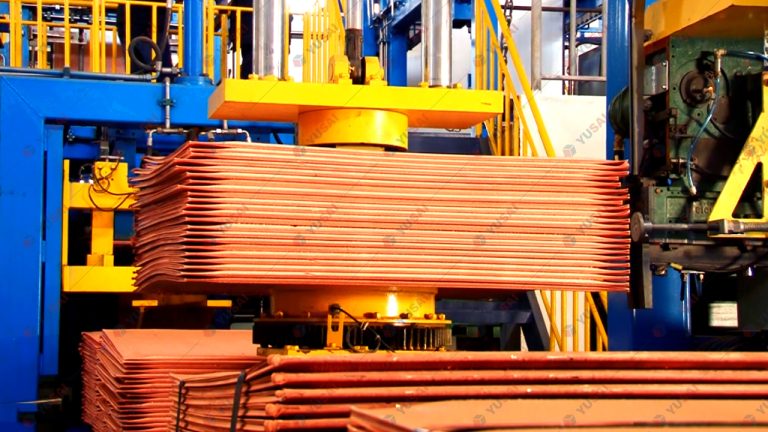
Both routes converge on the same permanent cathode platform: 316L stainless steel cathode plates with insulating edge strips, an overhead automatic crane with millimetre-level positioning, a robotic cathode stripping unit, cathode washing and drying, and short-circuit monitoring across the cell house. Cathodes are harvested on a fixed cycle, stripped, washed, dried, weighed, strapped and packed for delivery.
Finished products
The primary product is copper cathode sheet with a copper content of 99.99% and above, meeting LME Grade A as defined by EN 1978 (Cu-CATH-1) and equivalent to ASTM B115 and GB/T 467 grades. Cathode plate thickness is designed in the 5–10 mm range so the sheets are robust enough to handle and stack while keeping the electrodeposition cycle economical. Each batch is verified against four acceptance criteria: chemical composition, surface quality, unit weight, and electrical conductivity.
The copper cathode production line also produces three secondary revenue streams that are frequently overlooked when a project is costed: anode slime carrying gold, silver and platinum-group metals — copper anode slime can contain gold at concentrations up to 11 wt%, far above any primary ore — anode scrap returned to the melting furnace, and nickel salts recovered from the electrolyte purification bleed.
The finished copper cathode feeds directly into downstream production: copper wire rod and continuous casting, cable and conductor manufacturing, electrical engineering, busbars, machine building and power equipment.
Recovery Value Analysis
Why grade matters more than volume
Copper cathode is a commodity priced against the London Metal Exchange benchmark. What separates a profitable plant from a marginal one is not how many tonnes it moves, but whether the output is registrable as Grade A. Cathodes that meet the LME Grade A specification trade at the benchmark and attract physical premiums — Codelco, for example, has offered European customers premiums of USD 325 per tonne for 2026 — while off-spec cathodes are discounted against the same benchmark. Copper prices have moved sharply higher and briefly traded above USD 14,500 per tonne intraday in January 2026, with the IEA noting that smelters are simultaneously facing mounting strategic pressure from feed costs and treatment charges. In that environment a purity shortfall of a few hundredths of a percent translates into a permanent discount on every tonne shipped. Meeting Grade A on the first batch, and holding it, is the single largest value lever in the project.
Where the metal value comes from
On the anode route the upgrade is straightforward and measurable: feed at 98–99% copper is converted into product at 99.99%, and the price spread between the two grades accrues to the plant. Because the input is already metallic copper, the energy required to move from anode to cathode is a fraction of what a smelting operation consumes — electrorefining is an electro-chemical purification step, not a reduction step.
On the SX-EW route the value creation is much larger per tonne of ore. Oxide ore grading well below 1% copper is leached, concentrated by solvent extraction and plated out as cathode at 99.99%. Reference SX-EW projects achieve copper leaching rates above 94%, washing efficiency of approximately 94% and overall copper recovery in the region of 88% — the gap between those numbers is where recoverable value is lost, and it is the part of the design we focus on hardest.
The by-product value most projects underestimate
Anode slime is not waste. As insoluble noble metals concentrate in the cell bottom sludge, the gold content of copper anode slime can reach 11 wt% — orders of magnitude above the grade of a primary gold ore. Silver, platinum and palladium report to the same stream. A copper cathode line that treats slime as a disposal problem is discarding a parallel precious-metal business; a line that is designed with slime collection, thickening, filtration and a recovery route built in captures it. We size the slime handling section at the design stage so the by-product circuit can be extended later without rebuilding the cell house.
Electrolyte purification produces a second recoverable stream. Base-metal impurities accumulate in the circulating electrolyte and must be bled off to protect cathode quality. Handled with membrane separation and extraction–crystallisation, that bleed yields saleable nickel salts instead of a waste acid stream that has to be neutralised and paid for.
Operating cost drivers
Four numbers determine the cash cost of a cathode, and all four are designed, not inherited:
- DC energy per tonne of copper. Reference electrowinning plants consume approximately 1,800–2,500 kWh per tonne of cathode copper. This is set by current density, cell voltage and, critically, by the quality of the busbar and contact design — poor contacts and uneven current distribution show up directly on the electricity bill.
- Water per tonne of copper. Reference figures are in the range of 5–8 m³ per tonne. A closed-loop electrolyte circuit and staged cathode washing bring this down and reduce effluent treatment cost at the same time.
- Reagent consumption. Sulphuric acid make-up, extractant losses in SX-EW and flocculant consumption in leaching and washing.
- Availability, not throughput. A tankhouse that runs 350 days a year at design current density beats a larger tankhouse that loses days to short circuits, anode passivation and cathode stripping downtime. Short-circuit monitoring, reliable crane positioning and a proper anode preparation unit protect the uptime that the financial model assumes.
What decides your payback
Three inputs set the return on investment, and all three can be measured before a contract is signed: the assayed grade and impurity profile of your feed, the recovery rates your specific feed can actually achieve, and the delivered quality of your cathode against the Grade A specification. Our free feed assay and bench-scale testwork exist precisely to replace assumptions on all three with measured numbers — because a payback calculation built on an assumed recovery rate is not a payback calculation.
Applicable Materials
Feedstock accepted by the electrorefining (ER) route
- Copper anode plates and blister copper — the primary and preferred feed; copper content 98% and above
- Mixed purple copper (No. 1 and No. 2 copper scrap) after melting and anode casting
- Copper alloy scrap and copper granule — brass and bronze-based scrap after separation and smelting
- Copper powder recovered from PCB and e-waste processing — requires pulse pole-changing power supply to prevent anode passivation
- Copper-containing spent solutions, etching liquors and plating rinse waters — routed to electrowinning or to extractive recovery
- Residual and scrap anodes returned from the cell house, remelted and recast
- Anode slime and copper-bearing residues from existing tankhouses, re-slurried and returned to the process
Feedstock accepted by the SX-EW route
- Copper oxide ore — heap leach, dump leach, agitation leach or vat leach
- Copper concentrate leach liquors and pressure-oxidation discharge liquors
- Low-grade mine water, pit water and heap leach PLS with copper in the low grams-per-litre range
- Copper-bearing effluent from electroplating, PCB manufacturing and metal surface treatment
- Copper hydroxide and copper cementate redissolved in acid
Material characteristics that matter
Three properties of the feed change the equipment specification, and we ask for all three before quoting:
- Copper content and mineralogy — determines the route (ER, SX-EW or combined) and the required leaching or melting equipment
- Impurity profile — arsenic, antimony, bismuth, nickel, cobalt, iron, tin, lead and precious-metal content. This sets the electrolyte purification capacity, the required anode plate thickness, and whether a pulse pole-changing rectifier is needed
- Physical form — loose scrap, briquetted scrap, molten metal, cast anode, powder, slurry or solution. Each form has a different feed and preparation section
Pretreatment requirements
Materials outside the standard scope
The line is engineered for copper recovery and is not offered as a polymetallic smelter. Feed streams with very high lead, zinc or tin content require upstream separation and a dedicated residue treatment route, which we scope as a separate package. Materials subject to specific local regulatory control — hazardous waste streams, radioactive or mercury-bearing feed — are assessed case by case before acceptance, and are covered in the feed assay stage rather than assumed.
Main Equipment
1.Feed preparation and anode making section
- Melting furnace — reverbatory, induction or anode furnace, selected for the feed form and throughput
- Copper scrap baling machine — densifies loose scrap for efficient charging
- Anode casting machine — disc pouring machine or semi-automatic anode casting line with cast-iron anode moulds
- Combustion and reduction system — burners, gas train and reduction control for oxygen removal before casting
- Cooling water system — closed circuit for mould and equipment cooling
- Anode plate handling and lifting system — transports cast anodes to the preparation area
Purpose: convert loose scrap, powder and molten metal into dimensionally consistent anode plates of controlled thickness and weight.
2. Anode preparation and shaping unit
- Anode conveying mechanism and traverse transfer car
- Anode straightening machine with high-speed lug milling for the hanger ears
- Anode washing and drying unit
- Anode weighing and rejection station
- Anode scrap washing and polishing machine — cleans residual anodes returned from the cells for remelting
Purpose: a straight, correctly milled anode makes full electrical contact, which is what keeps cell voltage low and current distribution even. This section has more effect on the electricity bill than any other.
3. Cell house
- Electrolytic cells — concrete or steel cells with acid-resistant lining (PP, PVC, FRP, epoxy or rubber), thermal insulation brick and acid-proof base
- 316L permanent stainless steel cathode plates with conductive rod and insulating edge strip, approximate service life of 10 years
- Anode plates and anode hanger bars
- Cathode and anode busbars, intercell connectors and current-carrying copper bars
- Cell covers and acid mist hooding
- Cell insulation, support and levelling system
Purpose: the electrochemical reaction vessel. Cell lining selection and busbar design together determine the tankhouse’s structural life — designed for up to 20 years of corrosion service — and its electrical efficiency.
4. Power supply and rectification
- Silicon rectifier or IGBT high-frequency digital pulse power supply
- Digital pulse automatic pole-changing control cabinet — reverses polarity on a set cycle to break down anode passivation on high-impurity and powder-derived anodes
- Rectifier transformer, busbar and DC distribution system
- Current, voltage and cell-voltage monitoring instrumentation
Purpose: deliver stable, low-ripple DC current at the current density the process requires, and provide the pulse capability needed when recycled or powder-derived feed is used.
5. Electrolyte circulation and purification
- Circulation tanks and high-position tank (head tank)
- Heat exchanger and electrolyte heating device with temperature control
- Filtration system — full-volume filtration on every circulation pass
- Acid-proof pumps, valves and piping
- Electrolyte purification unit — copper removal by cyclone electrowinning or conventional electrowinning, membrane separation to split diluted acid from the nickel-bearing stream, and extraction plus evaporation–crystallisation to produce nickel salts
- Diluted acid return line — purified acid recycles back into the electrorefining circuit
Purpose: hold the impurity balance — arsenic, antimony, bismuth, nickel, cobalt and iron — inside specification so that cathode purity stays at 99.99% over the life of the plant, and recover the bleed as saleable nickel salts instead of effluent.
6. Cathode handling and finishing
- Overhead automatic crane and spreader with high-accuracy, millimetre-level positioning
- Robotic cathode stripping unit with cathode plate perpendicularity detection
- Cathode washing station and rapid air drying system
- Cathode embosser, sheet shears and nail-ear machine (for starter-sheet configurations)
- Cathode conveying, stacking, weighing and strapping/packing device
- Cathode stripping station and preparation stands for anode and cathode lifting frames
- Polishing machine and centrifugal machine
Purpose: strip, wash, dry, weigh and pack cathodes without bending them, without cross-contaminating the washed surface, and without manual handling that costs labour and injures product.
7. Residue and anode slime handling
- Anode slime collection, thickening and filtration system
- Filter press and slime drying unit
- Slime storage and transfer to the precious-metal recovery circuit
- Residual anode washing flume and draff washing flume
- Copper boiling flume, seed plate flume and washing flume
Purpose: capture the gold-, silver- and PGM-bearing anode slime as a contained product stream rather than a disposal problem.
9. Monitoring, control and environmental systems
- Short-circuit monitoring system across the cell house with cell-level fault location
- PLC / SCADA central control system with international-brand sensors and control elements
- Acid mist collection hooding and scrubbing system
- Off-gas treatment for the melting and casting section, including NOx and acid gas absorption
- Wastewater collection, diversion and treatment with recycling to the process
- Electrolyte leak detection and containment
Purpose: keep the plant safe, compliant and inspectable, and give the operator the data needed to run the tankhouse at design current density rather than at a defensive lower setting.
Copper Cathode Production Line Working Process
Route A — Electrorefining (ER), for copper anode and recycled copper
Step 1 — Feed assay and batching. Incoming copper anode, blister copper and scrap are sampled and assayed for copper and for impurity content. Batches are blended so the anode composition entering the furnace stays inside the range the electrolyte purification section is designed to handle.
Step 2 — Smelting and anode casting. In the anode route, copper-bearing feed is melted, oxidised to remove base-metal impurities, slagged off, then reduced to eliminate free oxygen. The refined copper is cast into anode plates of controlled thickness — typically 10–30 mm, since a thinner anode shortens the electrolysis cycle. Where pre-cast anodes are supplied directly, this step is bypassed.
Step 3 — Anode preparation. Cast anodes are straightened, the hanger lugs are milled to a clean conductive surface, and the plates are washed, dried and weighed. Faulty anodes are rejected here, before they enter a cell and waste current.
Step 4 — Cell loading. Anodes and 316L permanent stainless steel cathodes are loaded in alternating pairs. Spacing is maintained by hanger bar positioning and insulating edge strips, so every anode sees an identical cathode on both faces.
Step 5 — Electrolysis. DC current is applied across each anode–cathode pair. Copper dissolves anodically as Cu²⁺ and deposits on the cathode; noble metals report to the slime; soluble impurities are held in the electrolyte. Electrolyte is circulated continuously through the cells and the filtration circuit, with temperature held at the process setpoint, so that copper-ion concentration, acid concentration and temperature stay uniform from the first cell to the last.
Step 6 — Cathode harvest. At the end of the deposition cycle — approximately seven days for a standard cathode thickness, adjusted to the plate weight the customer requires — the cathodes are lifted from the cells by the automatic crane.
Step 7 — Stripping, washing and packing. The deposited copper is stripped from the permanent cathode plate, washed, air-dried, weighed, embossed and strapped or palletised. The stainless steel plates are cleaned and returned to service; they are reused indefinitely rather than consumed.
Step 8 — Anode scrap handling. Residual anodes are removed, washed to recover adhering slime and electrolyte, and returned to the melting furnace as internal recycle.
Step 9 — Slime collection. Anode slime is flushed from the cell bottoms on a fixed schedule, thickened, filtered and transferred to the precious-metal recovery circuit for gold, silver and PGM extraction.
Step 10 — Electrolyte purification. A bleed stream is drawn off before impurity levels reach the control limit, and is processed to remove copper and to separate diluted acid from the nickel-bearing solution. Acid returns to the tankhouse; nickel is recovered as nickel salts.
Step 11 — Quality control and release. Finished cathodes are sampled and verified for chemical composition, surface quality, unit weight and conductivity before release against the Grade A specification, with certificates issued per batch.
Route B — SX-EW, for copper oxide ore, leach liquors and low-grade solutions
- Step 1 — Crushing and grinding. Oxide ore is crushed, and milled where agitation leaching requires liberation.
- Step 2 — Leaching. Copper is dissolved in sulphuric acid by heap leaching, dump leaching, agitation leaching or vat leaching, depending on grade and mineralogy.
- Step 3 — Solid–liquid separation and washing. Thickening followed by counter-current decantation washing recovers the maximum amount of dissolved copper from the residue. Reference projects achieve washing efficiency close to 94%.
- Step 4 — Solvent extraction. The pregnant leach solution is contacted with an organic extractant that selectively loads Cu²⁺ and rejects iron and other impurities. The loaded organic phase is washed and then stripped back into a clean, concentrated electrolyte. Raffinate returns to the leach circuit.
- Step 5 — Electrowinning. Copper is deposited from the purified electrolyte onto permanent stainless steel cathodes under DC current.
- Step 6 — Cathode finishing. Harvest, strip, wash, dry, weigh and pack, as in Route A.
- Step 7 — Quality control and release. Every batch is verified against the Grade A specification.
Process flow (text version, for reference and quotation)
Route A: copper anode / blister copper / copper scrap → feed assay and batching → smelting and anode casting → anode straightening, lug milling and washing → cell loading (anode + 316L permanent cathode) → electrolysis with continuous electrolyte circulation and purification → cathode harvest → stripping, washing, drying and packing → copper cathode, Cu ≥ 99.99%, LME Grade A; plus anode slime → gold, silver, PGM recovery; plus electrolyte bleed → nickel salts
Route B: copper oxide ore / copper-bearing solution → crushing and grinding → acid leaching → thickening and counter-current decantation washing → solvent extraction (loading and stripping) → electrowinning → cathode harvest → stripping, washing, drying and packing → copper cathode, Cu ≥ 99.99%, LME Grade A

Product Features
Grade A output by design, not by luck. The cell house, electrolyte purification capacity and anode preparation unit are sized together so that the cathode leaving the line meets the LME Grade A / Cu-CATH-1 specification from the first production batch, and keeps meeting it as impurity levels in the circulating electrolyte rise over months of operation.
Two process routes on one equipment platform. Electrorefining and SX-EW share the same permanent cathode technology, crane, stripping unit and finishing line. A plant that starts on one route can add the other without rebuilding the tankhouse.
Permanent 316L stainless steel cathodes. Cathode plates carry an insulating edge strip and are reusable for approximately ten years, eliminating the starter-sheet production loop, its labour, and the copper inventory it ties up.
Digital pulse power with automatic pole changing. Where the feed is copper powder from PCB recycling, alloy scrap or other high-impurity material, conventional DC electrolysis passivates the anode and the cell stops working. Pulse pole-changing reverses polarity on a programmable cycle, breaks down passivation and loosens the anode slime so it releases instead of blanketing the anode.
High current density operation. The line is designed for current densities of 200–350 A/m², which reduces the number of cells and the tankhouse footprint needed for a given output, and therefore the building and busbar capital cost.
Integrated electrolyte purification. Arsenic, antimony, bismuth, nickel, cobalt and iron are removed on a controlled bleed with membrane separation of the acid stream, so the tankhouse runs closed-loop on acid and produces nickel salts rather than spent acid effluent.
Short-circuit monitoring at cell level. A shorted cell produces no cathode while consuming full power. Cell-level detection and location lets the operator clear faults in minutes instead of discovering them from a production shortfall at month end.
Anode slime treated as product, not waste. Slime collection, thickening, filtration and transfer to a precious-metal recovery circuit are built into the design, with the section sized so the by-product circuit can be extended later.
Corrosion engineering throughout. Acid-resistant cell linings, acid-proof pumps, valves and piping, internal anti-corrosion treatment of the workshop structure, and insulating components selected for a design service life of up to 20 years in a sulphuric acid and acid mist environment.
Automation that cuts labour, not control. Automatic crane with millimetre-level positioning, robotic cathode stripping, automatic anode preparation and PLC/SCADA supervision — reference installations report labour cost reductions of around 50% against manual operation, while keeping the operator in command of the process variables that matter.
Environmental containment by default. Acid mist hooding and scrubbing, off-gas treatment including NOx absorption on the melting section, closed-loop process water, and wastewater diversion with treatment and reuse.
Modular and expandable. The line starts at a compact single-train scale and expands by adding cell banks, so capital is committed in step with market demand rather than ahead of it.
Technical Parameters
Values below are typical design ranges for a YuSai Machinery copper cathode production line. Final values are fixed by the client’s feed assay and by bench-scale or pilot testwork, and are issued in the process design package. Rows marked † are confirmed per project against feed chemistry and site conditions.
Feed and product
| Parameter | Specification / Typical range | Note |
|---|---|---|
| Feed material (ER route) | Copper anode plate, blister copper, mixed purple copper, copper alloy scrap, copper powder from PCB recycling, copper-bearing spent solutions | Pre-cast anode or loose feed accepted; loose feed requires the anode making section |
| Feed copper content (ER route) | ≥ 98% Cu | Lower grades routed to smelting or to the SX-EW route |
| Feed material (SX-EW route) | Copper oxide ore, concentrate leach liquor, heap leach PLS, copper-bearing effluent, copper hydroxide / cementate | Works from low grams-per-litre copper concentrations |
| Finished product | Copper cathode (electrolytic copper), sheet form | — |
| Product purity | Cu ≥ 99.99% | — |
| Product standard | LME Grade A · EN 1978 Cu-CATH-1 · ASTM B115 · GB/T 467 | Verified per batch |
| Cathode plate thickness | 5–10 mm | Set with the deposition cycle |
| Cathode unit weight | Project-specific design value † | Determined by cell and crane design |
| Acceptance criteria | Chemical composition · surface quality · unit weight · electrical conductivity | Certificate issued per batch |
Electrical and power
| Parameter | Specification / Typical range | Note |
|---|---|---|
| Rectifier type | Silicon rectifier or IGBT high-frequency digital pulse power supply | Pulse type required for high-impurity and powder-derived feed |
| Power control mode | Digital pulse, automatic pole changing with programmable cycle | Prevents anode passivation |
| Current density | 200–350 A/m² | High-current-density design available |
| Cell voltage | 2–3 V (electrowinning) † | Electrorefining cells operate at lower cell voltage |
| Working voltage | 380 V ± 10%; 415 V / 440 V available on request | Matched to local power conditions |
| DC power consumption | 1,800–2,500 kWh per tonne of cathode copper (EW route) | Depends on current density, cell voltage and busbar design |
| Busbar and contact design | Optimised to minimise contact losses | Directly affects energy cost per tonne |
Cell house and process
| Parameter | Specification / Typical range | Note |
|---|---|---|
| Electrolytic cell | Acid-resistant lined cell (PP / PVC / FRP / epoxy / rubber) with thermal insulation | Design service life up to 20 years |
| Cathode plate | 316L permanent stainless steel with conductive rod and insulating edge strip | Approx. 10-year service life |
| Anode plate thickness | 10–30 mm | Thinner anodes shorten the electrolysis cycle |
| Electrolyte | H₂SO₄ + CuSO₄ aqueous solution | Low acid concentration, water-soluble, safe to handle |
| Electrolyte temperature | Controlled at process setpoint, typical 55–65 °C † | Heating device and heat exchanger included |
| Electrolyte circulation | Continuous circulation with full-volume filtration on every pass † | Keeps ion concentration and temperature uniform across the tankhouse |
| Cathode deposition cycle | Approx. 7 days per harvest | Adjusted to target cathode thickness and weight |
| Residual anode rate | Below 15% with permanent cathode technology | Industry benchmark; starter-sheet operation typically 18–22% |
| Metal extraction efficiency | > 85% for cyclone electrowinning on low-copper electrolyte | Recovers residual copper from the purification bleed |
| Copper recovery (SX-EW reference) | Leaching rate > 94% · washing efficiency ~ 94% · overall copper recovery ~ 88% | Reference SX-EW project values; confirmed by testwork |
| Cathode quality control | Chemical composition, surface quality, unit weight, conductivity | Full batch traceability |
Materials, utilities and automation
| Parameter | Specification / Typical range | Note |
|---|---|---|
| Water consumption | 5–8 m³ per tonne of cathode copper † | Reduced by closed-loop electrolyte circulation and staged washing |
| Cell house construction materials | 316L stainless steel, PP / PVC / FRP, epoxy-lined steel, rubber-lined steel | Selected per stream and temperature |
| Automation level | Automatic crane with ± 2 mm positioning · robotic cathode stripping · anode preparation unit · PLC/SCADA central control | Modular; automation scope agreed at design stage |
| Monitoring | Short-circuit monitoring with cell-level fault location · cell voltage and current monitoring | — |
| Instrumentation | International-brand sensors and control elements | Long-term spares availability |
Environment and compliance
| Parameter | Specification / Typical range | Note |
|---|---|---|
| Acid mist control | Cell hooding with collection and scrubbing | Tankhouse working environment |
| Off-gas treatment | Acid gas and NOx absorption for the melting and casting section | Sized to local emission limits |
| Process water | Closed-loop electrolyte; recycling of treated wastewater | Target of no spent acid discharge |
| Anode slime | Collected, thickened, filtered and transferred to precious-metal recovery | Au / Ag / PGM recovery circuit |
| Electrolyte bleed | Membrane separation of diluted acid; nickel recovered as salts | Acid returned to the tankhouse |
| Certification support | CE / ISO documentation, material certificates, test reports | Project-specific scope † |
Marked values are typical industry ranges issued as design guidance; they are confirmed for each project against the client’s feed assay, site conditions and testwork results, and are documented in the process design package.
Core Advantages
We publish the parameters our competitors keep private. Most suppliers of copper cathode production lines describe the process in general terms and stop there. We issue a structured parameter table covering current density, cell voltage, electrolyte conditions, cathode cycle, cathode specification and utility consumption, so your engineering team can evaluate the design before they contact us — and so your own engineers can verify it after delivery.
Grade A is a specification we can name. We align the delivered product to LME Grade A, EN 1978 Cu-CATH-1, ASTM B115 and GB/T 467, and we define the acceptance criteria your inspector will use — composition, surface, unit weight, conductivity. “99.99%” as a standalone claim is not a specification.
We solve the impurity problem rather than assuming it away. Arsenic, antimony, bismuth, nickel, cobalt and iron behave in three different ways in a copper tankhouse, and all three damage cathode quality if unmanaged. Our line integrates full-volume electrolyte filtration and a purification circuit with membrane acid separation and nickel salt recovery — the part of a copper refinery that determines whether 99.99% holds in year five or only in month one.
We build for recycled and powder-derived feed. Copper powder from PCB and e-waste processing, alloy scrap and mixed purple copper are the fast-growing feedstock of the industry, and they passivate anodes under conventional DC electrolysis. Our digital pulse power supply with programmable automatic pole changing is specified for exactly this feed, not offered as an afterthought.
We treat anode slime as a revenue stream. Slime collection, thickening, filtration and transfer to a precious-metal recovery circuit are designed in, with the section sized for later expansion. Copper anode slime can contain gold at concentrations up to 11 wt% — treating it as waste is an avoidable loss.
We engineer the environment, not just the equipment. Acid mist hooding, off-gas treatment with NOx absorption, closed-loop process water and containment of electrolyte leaks are part of the standard scope, because a tankhouse that cannot pass an environmental inspection cannot operate at design capacity.
One supplier, one process guarantee. Process design, equipment manufacturing, electrical and automation supply, installation supervision, commissioning and operator training come from a single team. There is no interface between vendors for a plant owner to arbitrate when the tankhouse does not reach design performance.
We start at the scale you can actually fund. The line is modular from a compact single train upward, and it expands by adding cell banks. You are not obliged to buy a 50,000-tonne tankhouse to enter the copper cathode business.
We test your material before you commit. Free feed assay and bench-scale testwork on your own anode, scrap, powder or leach solution — so the recovery rate in your financial model is a measured number rather than a supplier’s assumption.
Free engineering support on layout. Our process engineers will plan your site layout, propose the material flow and sizing for your specific feed and site conditions at no cost, before any commercial commitment.
Service Process
Stage 1 — Inquiry and feed data
Stage 2 — Free feed assay and testwork
We assay your sample for copper content and the full impurity profile, and where necessary run bench-scale leaching, extraction or electrolysis tests. You receive the test report, the recovery rates your material can realistically achieve, and the cathode grade the process will deliver. This is the stage that converts assumptions into measured numbers.
Stage 3 — Process design and proposal
Our engineers deliver the process flow diagram, equipment list and configuration, equipment layout drawing, utility requirements, automation scope and a commercial proposal with a costed equipment breakdown. Layout planning and material flow design for your site are provided at no charge.
Stage 4 — Contract and detailed engineering
On agreement we issue the detailed engineering package: general arrangement drawings, P&ID, electrical and automation drawings, foundation and civil interface drawings, utility connection schedules and the project schedule with milestones.
Stage 5 — Manufacturing and factory acceptance test
Equipment is manufactured, assembled for fit-up where applicable, inspected and tested before shipment. You receive inspection reports, material certificates and the factory test record, and you are welcome to attend inspection in person or send a third-party inspector.
Stage 6 — Shipping and documentation
We handle packing, marking, loading, and the export documentation set: packing list, commercial invoice, bill of lading, certificate of origin, and CE / ISO documentation as applicable to the project scope.
Stage 7 — Installation supervision
Our engineers travel to site to supervise erection, cell installation, levelling, busbar and piping connection, electrical installation and automation configuration. We work with your local contractors rather than replacing them.
Stage 8 — Commissioning and performance test
Cold commissioning, electrolyte preparation, first anode and cathode loading, and a supervised start-up run to reach design current density. The performance test verifies cathode grade against the agreed specification and confirms the recovery rate achieved on your feed.
Stage 9 — Operator training
On-site training for melting and casting, anode preparation, cell house operation, electrolyte circulation and purification, cathode stripping and packing, quality control, and short-circuit fault diagnosis. Trained operators are the difference between a plant that meets design output and one that does not.
Stage 10 — Warranty, spare parts and ongoing support
A defined warranty period with a recommended spares list, wear-part supply, and technical assistance by phone, email and remote diagnostic support. Optional scheduled maintenance visits and electrolyte monitoring as the tankhouse matures.
Fields to complete before publishing: warranty period and wording, spare-parts list, ISO certificate numbers, factory address, telephone / WhatsApp / email, and the enquiry form endpoint. These are company-specific and are marked here rather than filled with placeholder data.
FAQ
What purity of copper cathode does the line produce, and to which standard?
The line produces copper cathode with a copper content of 99.99% and above. It is designed to meet LME Grade A, the specification defined by EN 1978 (Cu-CATH-1), with equivalents in ASTM B115 and GB/T 467. Every batch is verified against four acceptance criteria — chemical composition, surface quality, unit weight and electrical conductivity — and issued with a certificate.
What is the difference between a copper electrorefining line and an SX-EW plant?
Electrorefining (ER) starts from metallic feed — copper anode plates or blister copper — and purifies it electrochemically in the cell house. SX-EW starts from copper oxide ore or copper-bearing solutions, dissolves the copper by acid leaching, concentrates and purifies it by solvent extraction, and then electrowins it in the same kind of cell. ER is the right route for recycled copper and smelter anode; SX-EW is the right route for oxide ore, low-grade liquors and effluent. Both routes share the same permanent cathode and cathode finishing equipment, which is why a plant can operate both.
Can the copper cathode production line process copper scrap instead of anode copper?
Yes. Mixed purple copper, copper alloy scrap and copper granule are smelted and cast into anode plates in the feed preparation and anode making section before entering the cell house. Where the scrap arrives as loose material, the melting furnace, baling machine and anode casting machine are included in the supply scope.
Can it handle copper powder from PCB recycling?
Yes, and this is one of the specific problems the line is designed for. Copper powder from PCB and e-waste processing produces anodes that passivate under conventional DC electrolysis and stop the cell working. Our digital pulse power supply with automatic pole changing reverses polarity on a programmable cycle, which breaks down passivation and helps the anode slime release from the anode surface.
How do you keep copper cathode purity at 99.99% over years of operation?
Impurities accumulate in the circulating electrolyte as production continues, and that accumulation — not the initial design — is what eventually damages cathode quality. Three mechanisms control it: full-volume electrolyte filtration on every circulation pass, continuous circulation with stable temperature, and a controlled electrolyte purification bleed that removes arsenic, antimony, bismuth, nickel, cobalt and iron. Copper is recovered from the bleed by cyclone electrowinning at an extraction efficiency above 85%, the acid is separated by membrane and returns to the tankhouse, and nickel is recovered as saleable nickel salts.
What happens to the gold and silver in the feed?
Gold, silver, platinum and palladium are more noble than copper and do not dissolve into the electrolyte. They report quantitatively to the anode slime at the bottom of the cell. The line includes slime collection, flushing, thickening and filtration, and transfers the slime to a precious-metal recovery circuit. Copper anode slime can contain gold at concentrations up to 11 wt%, which makes this a significant revenue stream rather than a waste disposal item. The slime handling section is sized at the design stage so the downstream recovery circuit can be added or expanded later.
What current density does the copper cathode production line operate at?
The line is designed for current densities of 200–350 A/m². Higher current density means fewer cells and a smaller tankhouse for the same output, which reduces building, busbar and civil capital cost. It also increases DC energy consumption per tonne, so current density is an economic optimisation rather than a fixed number — we set it against your power price and capital budget.
What are the energy and water consumption figures?
Reference electrowinning plants consume approximately 1,800–2,500 kWh of DC electricity per tonne of cathode copper, and 5–8 m³ of water per tonne. The actual figures depend on current density, cell voltage, busbar and contact design, and on how far the process water circuit is closed. These are calculated explicitly for your project in the design package rather than quoted as a fixed number.
How long does a copper cathode project take from order to first cathode?
The schedule is built from four phases: detailed design, equipment manufacturing, installation and commissioning. Timing depends on the route, capacity and site readiness. We issue a milestone schedule with the proposal, and the critical path in almost every project is the power supply and site civil works rather than equipment manufacturing.
What does the copper cathode production line need from the site?
Principal requirements are a level tankhouse building with acid-resistant floor and drainage, a power supply matched to the rectifier rating, process water, compressed air, and a heating source if an anode furnace is included. We issue a utilities and civil interface schedule with the detailed engineering so your civil contractor can work to fixed loads and connection points.
Can the capacity of the copper cathode production line be expanded later?
Yes. The line is modular. Expansion is achieved by adding cell banks and the corresponding rectifier capacity, which is why we ask about your medium-term production target at the design stage — busbar routing, cell house layout and the electrolyte circulation circuit are laid out so the future cells can be added without rebuilding what exists.
Do you test our copper material before we buy?
Yes. We assay your sample for copper and the full impurity profile, and where necessary run bench-scale leaching, extraction or electrolysis tests. You receive the test report and the recovery rates and cathode grade the process will realistically achieve on your material — before any commercial commitment.
How is the equipment protected against acid corrosion?
Electrolytic cells are lined with acid-resistant materials — PP, PVC, FRP, epoxy or rubber — over a thermally insulated base. Pumps, valves and piping are acid-proof rated. The workshop structure receives internal anti-corrosion treatment. Cathode plates are 316L stainless steel with insulating edge strips and an approximate ten-year service life, and the cell house is designed for up to 20 years of corrosion service.
What environmental controls are included in the copper cathode production line?
Acid mist is captured by cell hooding and treated in a scrubbing system. The melting and casting section is equipped with off-gas treatment including NOx and acid gas absorption, sized to the local emission limits you specify. Process water runs in a closed loop with electrolyte recycling, wastewater diversion and treatment, and a design target of no spent acid discharge.
What kind of automation does the copper cathode production line include?
The standard scope includes an overhead automatic crane with millimetre-level positioning, a robotic cathode stripping unit, an automatic anode preparation and shaping unit, short-circuit monitoring with cell-level fault location, and PLC/SCADA central control with international-brand sensors. The automation scope is agreed at the design stage so that you buy the level of automation your labour cost structure and operating philosophy justify — not a fixed package.
How much labour does the copper cathode production line require?
Reference installations report that automatic control reduces labour cost by around 50% compared with manual operation. Actual headcount depends on capacity, automation level and shift pattern; we provide an indicative manning schedule with the proposal.
Do you provide installation supervision and operator training?
Yes. Our engineers supervise erection, cell installation, levelling, busbar and piping connection, electrical installation and automation configuration, working alongside your local contractors. Commissioning includes electrolyte preparation, first cell loading and a supervised start-up run to design current density. On-site operator training covers melting and casting, anode preparation, cell house operation, electrolyte circulation and purification, cathode stripping and packing, quality control and short-circuit diagnosis.
What is the warranty and after-sales arrangement?
The warranty period and scope, the recommended spare-parts list and the after-sales response terms are agreed per contract and stated in the commercial proposal. Our after-sales support combines telephone, email and remote diagnostic assistance with optional scheduled maintenance visits and periodic electrolyte monitoring as the tankhouse matures.

Get A Free Quote
Fill in the form below and our service team will get back to you within 24 hours with a recommended process flow and quotation.
- +86 18339216321
- info@yusaipreciousmetals.com
- Zhengzhou.Henan.China
If you be interested in our equipment and solutions, please to contact us.
- +86 18339216321
- info@yusaipreciousmetals.com
- zhengzhou.henan.china