
Copper Electrolytic Refining Plant
— Turnkey Copper Electrolytic Refining Plant
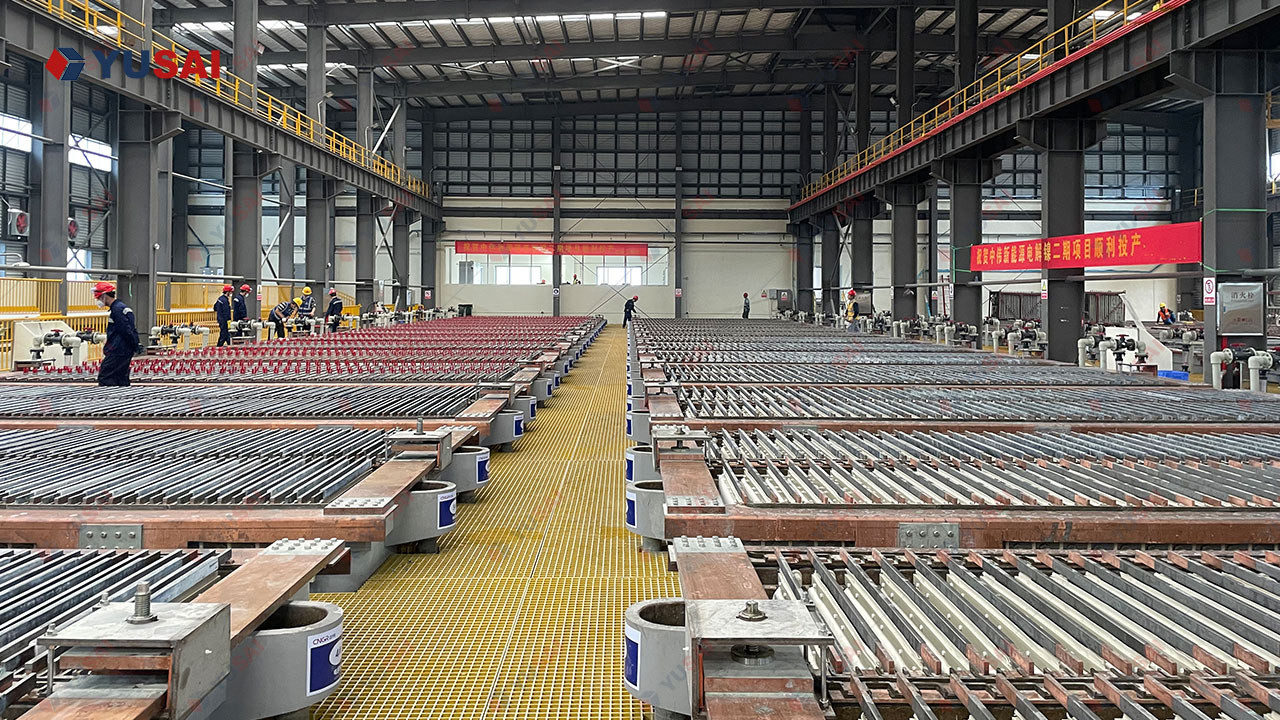
A copper electrolytic refining plant is a turnkey production line that converts copper-bearing scrap, blister copper and PCB-recovered copper powder into 99.99% (4N) cathode copper conforming to Cu-CATH-1 (GB/T 467) and LME Grade A.The line combines fire refining and anode casting with pulse electrorefining, electrolyte purification, cathode handling, anode slime precious metal recovery and closed-loop acid mist, NOx and wastewater treatment. Comprehensive copper recovery is 95%+ at a current efficiency of ≥ 95%, and 99.999% (5N) copper can be produced on request for high-purity applications. Every plant is configured to the customer’s own feed grade, site and target output, and is delivered, installed and commissioned under a single contract.
Product Overview
Copper electrorefining is the electrochemical purification of copper: impure copper anodes are dissolved in a copper sulfate–sulfuric acid electrolyte and pure copper is selectively re-deposited on the cathodes, while elements more noble than copper — gold, silver, platinum and palladium — do not dissolve and settle as anode slime. No chemical route can remove every impurity from copper, but electrorefining reliably delivers 99.99% cathode copper, which is why it is the final purification step in essentially all commercial copper production.
Applicable feed. The plant refines copper-bearing secondary materials: scrap copper (wire, millberry, chopped cable), blister and crude copper, impure black copper, copper anode scrap and rejects, and the copper powder or mixed metal powder recovered from PCB and e-waste recycling lines. Feeds carrying tin, lead, nickel, arsenic, antimony and bismuth are handled by the same line, because these impurities are routed either to the fire-refining slag or to the anode slime and the electrolyte purification circuit instead of to the cathode.
Processing route. Feed is sorted, crushed, dried and de-ironed, then melted and fire-refined to remove easily oxidised impurities and to control residual oxygen before being cast into anode plates of 10–30 mm. The anodes are suspended in FRP / polymer-concrete cells holding a copper sulfate–sulfuric acid electrolyte at 60–65 °C; under IGBT pulse current at 250–380 A/m², copper dissolves from the anode and deposits on the cathode, while gold, silver, platinum and palladium settle as anode slime and the less noble impurities (As, Sb, Bi, Ni) are controlled through continuous electrolyte purification and bleed treatment.
Final products. The main output is 99.99% (4N) cathode copper, stripped, washed and inspected as Cu-CATH-1 / LME Grade A sheets suitable for copper rod, wire, busbar and tube production. Three side streams are monetised: a precious-metal-bearing anode slime that is washed, dried and smelted into a precious metal alloy for downstream Au / Ag / Pt / Pd refining; reusable electrolyte chemicals (copper sulfate and nickel sulfate) recovered from bleed treatment; and copper recovered from low-concentration solutions by cyclone electrowinning.
Recovery Value Analysis
Electrolytic refining turns a discounted commodity into a benchmark-grade product and keeps the precious metals in the operator’s own value chain. The economics work on three levels: the copper itself, the precious metals that leave with the anode slime, and the avoided losses.
- Grade uplift on the copper — scrap and blister copper trade at a discount to the refined-metal benchmark, while 99.99% Cu-CATH-1 / LME Grade A cathode copper is sold at the benchmark. Electrorefining captures that spread on the operator’s own feed instead of selling the discount away.
- Comprehensive copper recovery of 95%+ — current efficiency is ≥ 95% and the residual copper in bleed and wash solutions is recovered by cyclone electrowinning, producing standard cathode copper from solutions with copper content above 8 g/L and returning the remainder as black copper rather than discharging it.
- Precious metals stay in-house — gold, silver, platinum and palladium in the feed do not dissolve at the anode and are collected in the anode slime, which the plant washes, dries and smelts into a precious metal alloy. The slime is typically a small fraction of the anode mass but carries a disproportionate share of the feed value, and it leaves the plant as a controlled, assayed product rather than as wet residue sold at a discount.
- By-product chemicals — electrolyte bleed treatment recovers copper sulfate and nickel sulfate as usable products, and the acid mist / NOx scrubbing system converts absorbed gases into usable chemicals, so environmental control adds value instead of only cost.
- Operating cost levers — pulse power with anti-passivation control shortens the electrolysis cycle; automated cathode handling, automatic cranes, short-circuit monitoring and centralised control cut labour compared with manual shops; and precise temperature, current density and circulation control reduce specific energy consumption per tonne of cathode.
- Loss prevention — short-circuit monitoring, closed cells with acid mist suppression above 92%, and assayed slime custody records reduce the two classic losses of an electrolytic refinery: stray current losses and unaccounted precious metal losses.
Before you invest, test your own feed. Send a representative sample and we will measure copper and precious metal content and issue a recovery and mass-balance report, so the value calculation is based on your material rather than on assumptions.
Applicable Materials
The plant accepts any copper-bearing feed with a copper content of roughly 80% or higher, and it is specifically configured for feeds that carry precious metals. Higher-grade, cleaner feeds need less fire refining; complex PCB-derived feeds need more slag work and benefit most from pulse electrolysis.
- Scrap copper — wire, millberry, chopped cable, 90–99% Cu; clean, high-grade feed for direct anode casting
- Blister and crude copper — 96–99% Cu; the classic feed of a copper refinery
- Black copper and impure copper — 85–95% Cu; requires more fire refining to remove tin, lead and iron
- Copper powder from PCB and e-waste recycling — 80–95% Cu; carries Sn, Pb, Ni and precious metals, and is where pulse anti-passivation electrolysis matters most
- Copper anode scrap and rejects — 95–99% Cu; can be remelted into anodes or returned to the cells
- Copper sludge and precipitates — 60–90% Cu; requires drying and batching before smelting
- Copper alloy residues and dross — after dezincing or detinning, 80–97% Cu
- Precious-metal-bearing feeds — any of the above containing Au, Ag, Pt or Pd, which report to the anode slime
- Non-ferrous intermediates — cement copper, copper matte conversion products and nickel-bearing copper feeds (nickel is controlled in the electrolyte purification circuit)
Main Equipment
A complete plant consists of five functional groups: the pyrometallurgical section, the electrolysis circuit, the electrolyte purification circuit, the material handling and automation package, and the environmental control package. Each group is supplied as modules and sized to the customer’s feed and output, so the plant can be extended later without replacing what is already installed.
Pyrometallurgical section
- Refining furnace (tilting rotary or electric-arc type, natural gas, LPG or electric heating) with slag raking and reduction systems
- Charging, batching and feed preparation equipment: crusher, magnetic separator, vibrating screen, dryer
- Semi-automatic anode casting machine with anode moulds and the complete anode preparation line
- Slag handling and granulation equipment
Electrolysis circuit
- FRP or polymer-concrete electrolytic cells with covers, heaters, level control and stainless steel electrical contacts — corrosion-resistant construction selected from PP, HDPE, PVC and FRP according to the duty
- Anode and cathode busbar system with low-voltage-drop design
- Cathode starting sheets (copper starter sheets) or 316 stainless steel permanent cathode plates (ISAKIDD-type) with automated stripping
- IGBT digital pulse rectifier with automatic pole changing; the rectifier is isolated from acid-laden workshop air to extend service life
- Electrolyte circulation system: pumps, piping, plate heat exchangers or heaters, filtration and flow distribution
- Cathode stripping, washing, sampling and packing machine; permanent cathode cleaning and preparation unit; anode scrap washing and packing unit
Electrolyte purification circuit
- Bleed treatment with evaporative crystallisation to recover copper sulfate and nickel sulfate
- Impurity removal for arsenic, antimony and bismuth (ion exchange or electrowinning options)
- Cyclone electrowinning unit for high-efficiency copper recovery from low-concentration solutions (> 85% efficiency, from solutions above 8 g/L Cu)
Material handling and automation
- Automatic crane or anode/cathode transfer system for cells
- Short-circuit detection and monitoring system
- PLC / HMI control system with touch-screen operation: current and voltage setting, heating and circulation control, electrolyte temperature, cell voltage, current and busbar temperature monitoring
- Parameter logging and historical query for electrolysis cycles, with automatic interlock that trips the rectifier when parameters deviate from the set limits
Environmental control package
- Covered cells with acid mist scrubbing (suppression efficiency above 92%)
- NOx scrubbing for the smelting section, with absorption products recovered as usable chemicals
- Wastewater treatment and recycling circuit, including slime wash water
- Anode slime washing, filtration, drying and smelting furnace (reduction and oxidation smelting, water granulation) for precious metal alloy production
Working Process
The working process runs from feed preparation through fire refining and anode casting to pulse electrorefining, cathode harvesting, electrolyte purification, anode slime treatment and emissions control.In the electrolysis step, anodes and cathodes are placed alternately in the cell; when direct current is applied, copper dissolves from the anode, migrates through the electrolyte and deposits on the cathode, while insoluble impurities settle to the cell bottom as anode slime.
Step by step:
- Feed preparation — sorting, crushing, drying, magnetic separation and batching, so the charge is uniform and the smelting conditions are stable.
- Fire refining — the charge is melted; tin, lead, iron and aluminium are removed as slag through oxidation and slagging, then the melt is reduced with natural gas to bring residual oxygen down to the required level.
- Anode casting — the refined copper is cast into anode plates of 10–30 mm with controlled thickness and weight tolerance, and the anode lugs are kept flat for good electrical contact.
- Electrorefining — anodes are hung in FRP / polymer-concrete cells filled with copper sulfate–sulfuric acid electrolyte at 60–65 °C; the IGBT pulse rectifier applies 250–380 A/m² and periodically reverses the current, keeping the anode active, shortening the cycle and releasing the anode slime. Copper deposits on the cathode at ≥ 95% current efficiency while gold, silver, platinum and palladium settle in the slime.
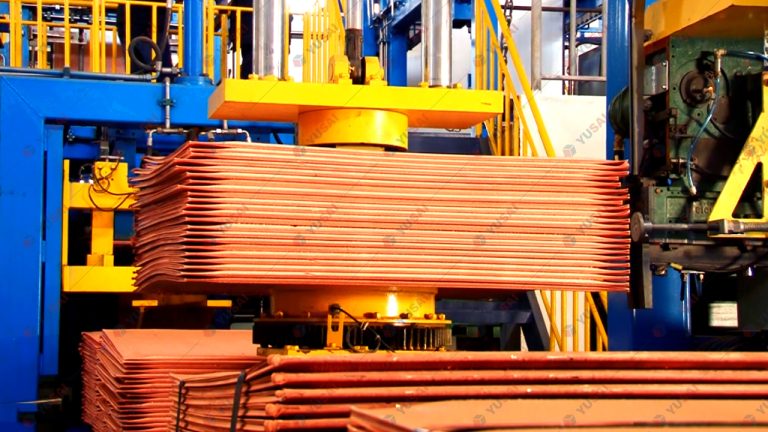
- Cathode harvesting — cathodes are lifted by automatic crane, stripped (from permanent stainless steel plates or copper starter sheets), washed, sampled, weighed and packed as Cu-CATH-1 / LME Grade A cathode copper.
- Electrolyte purification — a bleed stream is taken continuously; copper and nickel are recovered as sulfate crystals, arsenic, antimony and bismuth are removed by ion exchange or electrowinning, and the purified electrolyte returns to the cells in a closed loop.
- Anode slime treatment — slime is washed free of entrained electrolyte, filtered, dried and smelted (reduction followed by oxidation smelting), then water-granulated into a precious metal alloy for downstream Au / Ag / Pt / Pd refining, with assayed custody records throughout.
- Emissions and residue control — cells are covered and connected to acid mist scrubbing (> 92% suppression), NOx from smelting is absorbed in a scrubber whose products are recovered as usable chemicals, and process and wash water is treated and recycled.
Product Features
The plant is built around three design priorities: keeping the anode active on complex feeds, keeping the operator’s value chain closed, and keeping the emissions inside the plant. The features below are the practical consequences of those priorities.
- Anti-passivation pulse electrolysis — IGBT digital pulse power with automatic pole changing suppresses anode passivation on high-impurity PCB-derived copper, shortens the electrolysis cycle and helps anode slime release cleanly; pulse and reversal timing is set from the control cabinet.
- Benchmark-grade output — 99.99% (4N) cathode copper conforming to Cu-CATH-1 (GB/T 467) and LME Grade A, with 99.999% (5N) available on request for high-purity applications.
- Two cathode technologies available — copper starter sheets for lower capital cost, or 316 stainless steel permanent cathode plates with automated stripping (ISAKIDD-type) for high labour efficiency and consistent cathode quality.
- High current efficiency and low specific energy — ≥ 95% current efficiency with specific energy consumption reduced by precise current density, temperature and circulation control.
- Corrosion-resistant construction — cells and wetted parts in PP, HDPE, PVC, FRP or polymer concrete selected for sulfuric acid duty, with a service life of 10 years and above, and titanium-coated copper for the current-carrying contacts.
- Closed cells with acid mist capture — covered cells and scrubbing achieve more than 92% acid mist suppression, protecting both the working environment and the busbars, hangers and steelwork around the cells.
- Integrated electrolyte purification — continuous bleed treatment removes As, Sb and Bi, recovers copper sulfate and nickel sulfate, and returns purified electrolyte to the cells, so cathode quality does not drift as impurities accumulate.
- Full in-house precious metal circuit — anode slime is washed, dried, smelted and granulated on site, and the alloy leaves under assayed custody records.
- Automation and safety interlocks — automatic crane, cathode stripping, permanent-plate cleaning and short-circuit monitoring, governed by a PLC control system that monitors electrolyte temperature, cell voltage, current and busbar temperature and trips the rectifier on deviation.
- Modular, expandable layout — delivered as modules for straightforward installation and commissioning, and expandable by adding cell groups rather than rebuilding the plant.
- Environmental closing loop — acid mist and NOx scrubbing with chemical recovery, plus wastewater treatment and recycling, so the plant operates as a closed loop rather than an open discharge.
Technical Parameters
| Parameter | Value |
|---|---|
| Product purity | 99.99% (4N) cathode copper, conforming to Cu-CATH-1 (GB/T 467) and LME Grade A |
| Optional high purity | 99.999% (5N) on request, with additional electrolyte control |
| Comprehensive copper recovery | 95%+ |
| Feed copper content | ≥ 80% Cu recommended (higher grade requires less fire refining) |
| Electrolyte composition | CuSO₄ + H₂SO₄; Cu 40–50 g/L; H₂SO₄ 160–200 g/L |
| Electrolyte temperature | 60–65 °C, controlled to ± 0.5 °C |
| Current density | 250–380 A/m² |
| Cell voltage | 0.20–0.35 V |
| Current efficiency | ≥ 95% |
| Specific energy consumption | Reduced by current density, temperature and circulation control; value confirmed per feed and site |
| Anode thickness | 10–30 mm (semi-automatic casting) |
| Anode weight tolerance | ± 2% |
| Electrolysis cycle | Shortened by pulse anti-passivation control; cycle time set per feed |
| Electrolyte additives | Glue / thiourea / chloride ion, dosed to keep the cathode deposit smooth |
| Electrolyte circulation | Continuous, with filtration and heat exchange |
| Impurity control | As, Sb and Bi removed from bleed by ion exchange or electrowinning; Ni recovered as nickel sulfate |
| Cell construction | FRP / polymer concrete / PP / HDPE / PVC, sulfuric-acid resistant, service life > 10 years |
| Current-carrying contacts | Titanium-coated copper, stainless steel electrical contacts |
| Cathode system | Copper starter sheets, or 316 stainless steel permanent cathode plates with automated stripping |
| Power supply | IGBT digital pulse rectifier with automatic pole changing; isolated from acid-laden workshop air |
| Low-concentration copper recovery | Cyclone electrowinning, Cu extraction efficiency > 85%, feed solutions above 8 g/L Cu |
| Acid mist suppression | > 92% |
| NOx control | Scrubber on the smelting section, absorption products recovered as usable chemicals |
| Wastewater | Treatment and recycling circuit, including anode slime wash water |
| Automation | PLC / HMI touch-screen control; monitoring of electrolyte temperature, cell voltage, current and busbar temperature; parameter logging and history query; automatic interlock trip on deviation |
| Monitoring & safety | Short-circuit detection and monitoring system, level control, temperature interlocks |
| Precious metals | Au / Ag / Pt / Pd concentrated in anode slime, smelted to a precious metal alloy |
Core Advantages
he core advantage is that this is one engineering package rather than a set of separate machines: the metallurgy, the automation and the environmental control are designed together, so the plant holds its purity and its emissions targets as a whole. The points below differentiate this offer from equipment-only suppliers.
- Standard-named purity, not just a number — output is specified against Cu-CATH-1 (GB/T 467) and LME Grade A, with sampling and assay protocols agreed in the contract, so the product is sellable against a recognised benchmark.
- Technology matched to the feed, not to a catalogue — feeds are assayed first; where PCB-derived copper causes passivation, pulse anti-passivation electrolysis is applied, and where slime carries high precious metal values, the smelting circuit is sized accordingly.
- Free feed testing before purchase — copper and precious metal content, plus a recovery and mass-balance report, so the investment case is built on measured data. This is a service competitors in this segment rarely offer.
- Precious metals kept in the operator’s value chain — a complete on-site slime washing, drying, smelting and granulation circuit with assayed custody records, instead of shipping wet residue at a discount.
- Low-concentration copper recovery included — cyclone electrowinning recovers copper from bleed and wash solutions at above 85% efficiency, so the copper that normally leaves as effluent becomes saleable cathode.
- Choice of cathode technologies — starter sheets or 316 stainless steel permanent plates with automated stripping, so the customer can trade capital cost against labour cost and cathode consistency.
- Acid mist and NOx designed in, not added later — > 92% acid mist suppression, covered cells, NOx scrubbing with chemical recovery, and a wastewater recycling circuit as standard scope.
- Corrosion-resistant, long-life construction — PP, HDPE, PVC, FRP and polymer concrete selected for sulfuric acid duty, titanium-coated copper contacts, and rectifiers isolated from acid-laden air.
- Automation that reduces both labour and loss — automatic crane, stripping, plate cleaning and short-circuit monitoring under PLC control, with interlocked protection that stops the rectifier when parameters deviate.
- Modular and expandable — installation in modules, and capacity growth by adding cell groups rather than replacing equipment.
- Documentation and training that transfer the process — process parameters, operating windows, assay protocols, maintenance schedules and operator training are part of the delivery, so the plant can be run and maintained locally.
- Warranty and spare parts continuity — 12–24 months’ warranty on major equipment, spare parts supplied at cost, and support for process optimisation after commissioning.
Service Process
The service process starts before the quotation: we assay the customer’s feed, then design the plant around the measured material and stay with the project through commissioning, training and process optimisation.Each stage below is a defined deliverable rather than a general promise.
- Test and analysis — send a representative sample; we measure copper and precious metal content and issue a recovery and mass-balance report. This is provided free of charge.
- Process design — metallurgical flowsheet, mass balance, reagent and utility consumption, and the definition of the operating window (current density, temperature, electrolyte chemistry, additives, circulation).
- Engineering package — general arrangement and layout drawings, equipment specifications, piping and electrical drawings, and the technical proposal with the commercial offer.
- Equipment supply and manufacturing — cells, busbars, rectifier, casting machine, circulation, purification, slime and environmental equipment, with progress photographs and inspection reports during manufacture.
- Electrical and automation integration — PLC / HMI programming, instrument calibration, monitoring and interlock configuration, and parameter logging set-up.
- Factory testing — sub-assembly testing and a trial run before dispatch, with third-party inspection available on request.
- Packing and shipping — export packing, container loading plans, and shipping documentation.
- Installation and commissioning — supervision on site (or remote guidance), mechanical and electrical installation checks, electrolyte make-up, first anode campaign and cathode quality verification against the agreed specification.
- Training — operator and maintenance training covering cell operation, anode and cathode handling, electrolyte control and dosing, slime handling and custody, safety procedures and troubleshooting.
- Acceptance and handover — agreed acceptance method based on assay of product and recovery, with the operating manual, drawings and assay protocols handed over.
- After-sales support — 24 / 7 remote support, spare parts supplied at cost, remote diagnosis, periodic performance review and process optimisation consultation.
FAQ
What is a copper electrolytic refining plant?
It is a plant that dissolves copper from impure anodes in a copper sulfate–sulfuric acid electrolyte and re-deposits it on cathodes, producing 99.99% pure cathode copper while gold, silver, platinum and palladium are concentrated in the anode slime. It is the final purification step in commercial copper production.
What purity can the plant achieve?
Standard output is 99.99% (4N) cathode copper conforming to Cu-CATH-1 (GB/T 467) and LME Grade A. With additional electrolyte control, 99.999% (5N) copper can be produced on request for high-purity applications.
Do you test my raw material before I buy?
Yes. Send a representative sample and we run a laboratory test to measure copper and precious metal content, then issue a recovery and mass-balance report. The test is free and is issued before any order is placed.
What raw materials can be processed?
Scrap copper (wire, millberry, chopped cable), blister and crude copper, black copper, copper powder from PCB and e-waste recycling, copper anode scrap and rejects, copper sludge and precipitates, copper alloy residues after dezincing or detinning, and other copper-bearing intermediates. Feeds with roughly 80% copper or higher are typical.
What is the difference between electrorefining and electrowinning?
Electrorefining uses a soluble copper anode that dissolves during electrolysis, so its purpose is purification. Electrowinning uses an insoluble anode and recovers copper from solution, for example leach solutions or electrolyte bleed. This plant includes electrorefining as the main circuit and offers cyclone electrowinning as a companion circuit for low-concentration copper recovery.
How is anode passivation handled?
By an IGBT digital pulse power supply with automatic pole changing. Periodic current reversal keeps the anode active on high-impurity PCB-derived copper, shortens the electrolysis cycle and helps the anode slime release from the anode surface instead of forming a passivating layer. Pulse and reversal intervals are adjustable from the control cabinet.
Can precious metals be recovered from the anode slime?
Yes. Gold, silver, platinum and palladium do not dissolve at the anode and report to the anode slime. The plant includes the slime washing, filtration, drying, smelting and water-granulation circuit that produces a precious metal alloy for downstream Au / Ag / Pt / Pd refining, with assayed custody records.
How are arsenic, antimony, bismuth and nickel controlled?
They accumulate in the electrolyte rather than in the cathode, so a continuous bleed stream is purified: copper and nickel are recovered as sulfate crystals, and arsenic, antimony and bismuth are removed by ion exchange or electrowinning. The purified electrolyte returns to the cells, so cathode quality does not drift over the campaign.
How are acid mist and NOx controlled?
Cells are covered and connected to an acid mist scrubbing system with more than 92% suppression efficiency. NOx from the smelting section is absorbed in a scrubber, and the absorption products are recovered as usable chemicals. Wastewater, including anode slime wash water, is treated and recycled.
What cathode technology do you recommend?
Copper starter sheets have lower capital cost and suit smaller or first-time plants. 316 stainless steel permanent cathode plates with automated stripping (ISAKIDD-type) give higher labour efficiency, more consistent cathode quality and better performance over long campaigns. We recommend the option that matches your capacity, labour cost and target cathode specification.
Can the plant be expanded later?
Yes. The plant is delivered as modules, and capacity is increased by adding cell groups and upgrading the rectifier and electrolyte circulation rather than replacing the installed equipment.
What utilities and site conditions are required?
Water, electricity and fuel (natural gas, LPG or electricity for the furnace), an acid-resistant floor and a ventilated hall for the cells, drainage to the wastewater circuit, and space for the slime handling area. A utilities and layout checklist is issued with the technical proposal once capacity is confirmed.
What are the warranty, lead time and payment terms?
Warranty is 12 months on major equipment, and payment is by T/T or irrevocable L/C at sight. Spare parts are supplied at cost, and installation and commissioning supervision is included in the agreed service scope.
Is installation and training included?
Yes. The standard scope includes on-site installation and commissioning supervision (or remote guidance where required), operator and maintenance training, and handover of the operating manual, drawings and assay protocols.

Get A Free Quote
Fill in the form below and our service team will get back to you within 24 hours with a recommended process flow and quotation.
- +86 18339216321
- info@yusaipreciousmetals.com
- Zhengzhou.Henan.China
If you be interested in our equipment and solutions, please to contact us.
- +86 18339216321
- info@yusaipreciousmetals.com
- zhengzhou.henan.china