
Copper Electrowinning Plant
— Turnkey Copper Electrowinning Plant
YuSai Copper Electrowinning Plant (CuEW) is a modular SX-EW tankhouse that recovers 99.99% Cu-CATH-1 cathode copper from copper-bearing leach solutions using insoluble anodes and 316L stainless-steel permanent cathodes. Copper is first transferred from an impure pregnant leach solution (PLS) into a clean sulphuric-acid electrolyte by solvent extraction, then reduced electrically onto the cathode plates — with no smelting furnace, no soluble anode and no anode scrap to re-melt.Every plant is engineered backwards from your own material: we test your ore, concentrate, tailings, PCB leach liquor or spent electrolyte, build the copper/water/acid balance, then size the cellhouse, rectifier and busbar around that balance.
Product Overview
A copper electrowinning plant is the final stage of a hydrometallurgical copper route. Where a smelter handles sulphide concentrates at high temperature, an SX-EW plant handles solutions: dilute copper in an acid leach liquor is concentrated, purified and then plated out as a finished, exchange-grade metal. That is why electrowinning plants are the standard solution for oxide ore bodies, low-grade and waste streams, mine water and — increasingly — for secondary copper recovered from electronic scrap and other recyclable feedstocks.
The three-stage logic of the plant. First, the feed: a copper-bearing liquor, typically produced by heap, dump, vat or agitation leaching, or generated as a process stream in a recycling or refining operation. Copper tenor in this liquor is low and the impurity load (iron, manganese, arsenic, antimony, bismuth, chloride) is high — far too high to plate metal from directly. Second, the process: solvent extraction moves copper ions into an organic phase and releases them into a clean, high-acid stripping solution, rejecting the impurities to the raffinate. The loaded electrolyte is filtered, tempered and dosed, then fed to the cellhouse where direct current reduces Cu²⁺ to metallic copper on 316L stainless-steel cathodes. Third, the product: a flat cathode plate of 99.99% copper, mechanically stripped from the blank, washed, weighed and bundled for direct sale — the same physical and chemical form that is traded on the LME and SHFE.
Electrowinning is not electrorefining — and the difference matters commercially. In electrorefining (ER), the anode is impure copper metal that dissolves as the cell operates; the copper comes from the anode, and anode scrap plus anode slime are part of the flow. In electrowinning (EW), the anode is insoluble — a rolled lead alloy or a coated titanium plate that never dissolves — and the copper comes entirely from the solution. Oxygen, not copper, is evolved at the anode. This is why an EW cell runs at roughly 2 V while an ER cell runs at 0.25–0.30 V, and why an EW plant consumes far more electrical energy per tonne of copper. It is also why an EW plant can treat a dilute, dirty leach solution that no electrorefining line could accept, and why it produces no anode scrap to recycle. If your feedstock is metallic copper (scrap wire, anode plates, black copper), you need an electrorefining line, not an electrowinning plant; if your feedstock is a solution, electrowinning is the only route to cathode metal without a smelter.
What determines the size of your plant. Cellhouse capacity is not a catalogue number — it is a function of five project-specific inputs: the copper tenor of your liquor, the current density you are willing to run, the current efficiency your chemistry allows, your available DC power supply, and your harvesting philosophy. Publishable “nameplate tonnage” figures on vendor pages are almost always decorative. YuSai fixes the cell count, cathode area, rectifier rating and busbar section only after the test campaign returns your actual mass balance — and that is exactly why this page publishes the operating window (current density, cell voltage, electrolyte chemistry, electrode geometry) instead of a single fictitious capacity.
Recovery Value Analysis
The economics of a copper electrowinning plant come down to one question: how much of the copper in your liquor becomes saleable Cu-CATH-1 cathode, and what does it cost to convert it? Every design decision on this page moves one of the eight value levers below.
1. Feed tenor versus cathode output. The recoverable metal is the product of liquor volume and copper concentration, less the copper deliberately left in the lean electrolyte. A cell operating window of 30–38 g/L Cu²⁺ in the rich electrolyte with a 2–5 g/L drop across the cell is the reason plants are designed around circulation flow per square metre of plating area (typ. 0.12 m³/h/m², max ≈0.14) rather than around a fixed cell count: flow control is what keeps the plating reaction fed.
2. Recovery rate — the single largest lever. Copper that leaves in the raffinate or the bleed is copper you paid to leach and did not sell. In a closed-loop SX-EW circuit with correctly sized extraction and stripping stages, copper recovery from the loaded solution is typically held in the mid-to-high 90s percent, and the recovery of a well-run overall route (leach + SX + EW) is governed far more by leach extraction than by the tankhouse. We therefore report expected recovery per stage — leach, washing, extraction, stripping, electrowinning — rather than a single marketing number.
3. Purity premium and market acceptance. Cathode that meets Cu-CATH-1 (BS EN 1978:2022 / GB/T 467-2010) or ASTM B115 Grade 1 chemistry is deliverable against exchange contracts; off-spec cathode is sold at a discount, blended, or re-processed. The step between “99.9%” and a documented 99.99% with element-level ppm control (Se, Te, Bi, As, Sb, Pb, Fe, S) is worth a real, recurring margin — and it is protected by electrolyte hygiene, not by luck. Section 8 gives the impurity ceilings we design against.
4. DC energy — the dominant operating cost. Electrowinning consumes roughly 1,900–2,000 kWh of DC energy per tonne of copper at ≈2 V and 90% current efficiency. Because the plant runs continuously, energy is the largest recurring line item and the one most sensitive to design: lower cell voltage (shorter electrode spacing, better contact, lower busbar loss), higher current efficiency (iron control, short-circuit elimination, temperature control) and, where justified, coated-titanium anodes — which remove the cobalt addition and lead-sludge handling and can cut energy consumption by up to 15%.
5. Consumables and reagents. Extractant and diluent losses, sulphuric acid make-up and consumption, cobalt sulphate to protect the lead anode, and a guar-gum smoothing agent at 150–300 g per tonne of copper are all predictable, measurable and controllable. A plant that publishes its consumption basis can budget them; a plant that does not, cannot.
6. Anode replacement cost. Insoluble anodes are consumed slowly and unevenly — 1–12 kg of anode per tonne of copper plated, with a 5–10 year service life for a good rolled Pb-Ca-Sn or Pb-Sr-Sn anode. Anode cost can represent a surprisingly large share of the mechanical equipment cost, which is why anode alloy specification and cobalt regime belong in the commercial discussion, not just the technical one.
7. Capital recovery on permanent cathodes. 316L stainless-steel permanent cathode blanks carry roughly a 10-year service life and eliminate the starter-sheet cycle of older tankhouses. Combined with automatic stripping, they cut labour per tonne, shorten the harvest cycle and improve operator safety — the three reasons every modern tankhouse is a permanent-cathode tankhouse.
8. Automation and labour. Per-cell voltage monitoring with short-circuit detection, IR thermal scanning, automated cranes and an automatic cathode stripping machine (120 plates/h standard, 450 plates/h for the large machine) together determine how many people run the cellhouse and how much copper is lost to shorts. This is usually the difference between a plant that pays back and one that merely operates.
How to read a payback number. Net annual value = (cathode tonnes × realised cathode price) − (DC energy × your power tariff) − reagents and consumables − anode replacement − labour − maintenance and spares − financing. Any vendor quoting a payback without showing those seven inputs is guessing. Give us your copper tenor, liquor flow, expected reagent consumption, power tariff, cathode price and target output, and we will return a feasibility-grade model with the sensitivities on energy price and current density — the two variables that move the result most.
Applicable Materials
The plant is designed around solutions, not around a single ore type. It accepts copper-bearing liquors from any upstream route that can deliver a clarified, reasonably clean feed to solvent extraction.
Primary copper sources
- Oxide copper ores — malachite, azurite, chrysocolla and mixed oxide bodies, the classic heap-leach SX-EW feedstock, including grades below 1% Cu that are uneconomic to smelt
- Secondary (supergene) sulphide ores — chalcocite and covellite from the transition zone, where the leach chemistry is adjusted rather than the plant
- Mixed oxide–sulphide ores — treated by staged or modified leaching, with the SX-EW circuit unchanged downstream
- Mine waste, low-grade stockpiles and tailings leachate — the traditional value-recovery target, where copper is recovered from material previously written off
- Mine water and pit drainage — dilute but continuous copper streams recovered as cathode
Secondary and recycling sources
- Copper-bearing leach liquors from electronic scrap and PCB processing — the copper fraction of e-waste leaching circuits, delivered to EW after SX purification
- Secondary copper and copper-alloy leach liquors — from scrap brass, bronze, copper wire and mixed copper residues processed hydrometallurgically
- Spent electrolyte, bleed and purification streams — copper recovered from tankhouse bleed before impurity purging, and from bleed-treatment circuits in electrorefining tankhouses
- Anode slime and precious-metal process streams — copper reporting to solution during anode slime or precious-metal refining, recovered as cathode rather than as low-value salt
- Battery and black-mass hydrometallurgy streams — copper removed as a by-product of NCM/LFP leaching circuits
Acceptance window — what we test before we quote
Every one of the following is measured on your sample, because each one changes an equipment or control decision: copper concentration (g/L) and the resulting rich/lean differential; iron at g/L level, since ferric/ferrous cycling directly consumes current and iron above roughly 3 g/L erodes current efficiency; chloride at mg/L level, because 30–40 mg/L improves deposit smoothness while higher chloride attacks steel cathode blanks and forces 316L specification; manganese, which can oxidise at the anode and foul cathodes and cause crud; arsenic, antimony and bismuth, which set the electrolyte bleed rate and the maximum achievable cathode grade; total dissolved solids and suspended solids feeding the SX and EW circuits; residual organic and entrained extractant; acidity and free acid; and feed temperature.
What is not a fit. Feed that is metallic copper rather than dissolved copper belongs in copper electrorefining. Liquors with extreme chloride, high organics or heavy suspended solids are handled, but require upstream conditioning that we specify in the proposal. Feed that cannot be clarified economically is the one genuine reason to stop.
Main Equipment
The plant is supplied as a numbered equipment schedule, with duty/standby philosophy and material specification stated per line item. A reference configuration for a complete SX-EW copper cathode plant:
- Feed conditioning unit — solution storage, pH/acidity adjustment, filtration or clarification ahead of solvent extraction
- Solvent extraction train — mixer-settlers in the required extraction / wash / stripping configuration (for example 3 extraction + 2 stripping stages per train, multiple parallel trains), with LIX984N-type oxime extractant, organic-phase pumps, coalescers and a loaded-organic surge tank
- Raffinate and organic handling — raffinate pumps and pond, crud treatment, organic recovery, extractant and diluent make-up and dosing
- Electrolyte conditioning — electrolyte filters, plate heat exchangers for temperature control, cobalt sulphate and smoothing-agent dosing stations, advance-electrolyte and lean-electrolyte storage, controlled bleed line
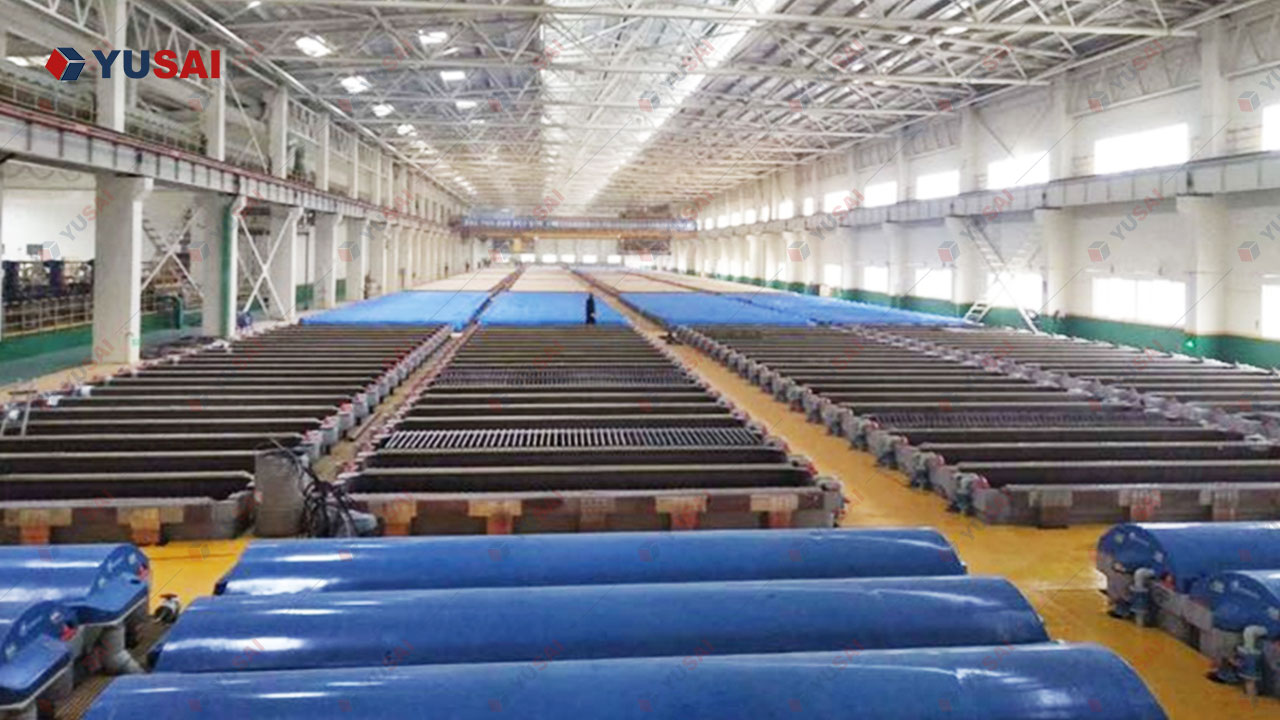
- Copper electrowinning cells — polymer-concrete cells, electrically insulated from ground and from each other, with cell capping boards, insulators, and drip trays
- Insoluble anodes — rolled Pb-Ca-Sn (or Pb-Sr-Sn) alloy anodes, dimensioned slightly narrower and shorter than the cathodes to reduce edge growth; coated-titanium (MMO) anodes offered as an option on plants where energy or cobalt-free operation is the priority
- Cathode plates — 316L stainless-steel permanent cathode blanks with copper hanger bars, edge strips and looped lifting bales
- Rectifier and transformer set (rectiformer) — 12-pulse DC power supply with transformer, sized in kA at the design current density, plus shorting frame, section switches and busbar
- Busbar system — inter-cell, inter-row and main busbar in copper, designed for low voltage drop; double-contact design and water-cooled sections where the current density demands it
- Cellhouse crane — overhead crane with cathode/anode handling frame, auto-positioning, and (for larger plants) remote or semi-automatic operation
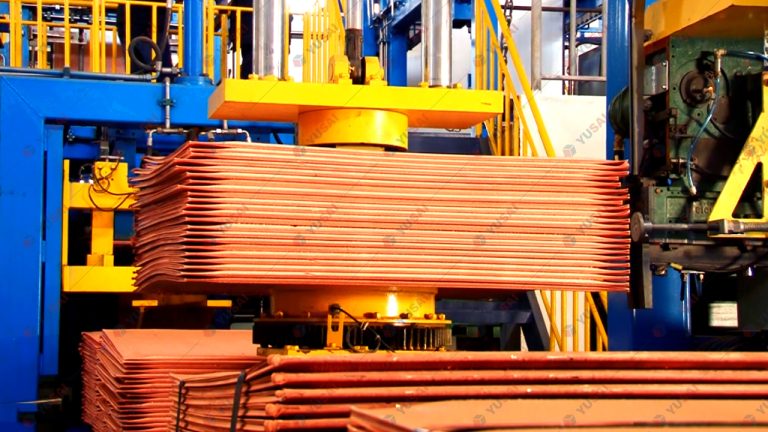
- Cathode stripping machine — automatic plate handling, copper stripping, blank washing and return, cathode washing, weighing and bundling station
- Anode and cell maintenance equipment — anode cleaning/straightening, anode sludge collection, cell cleaning tools, cathode blank refurbishment and edge-strip replacement
- Acid mist control system — cell hooding with exhaust capture, mist eliminators, and floating-ball / surfactant-bead suppression media
- Short-circuit detection and monitoring — per-cell voltage and temperature monitoring, plus IR thermal scanning on larger plants
- Control and automation — PLC/SCADA with electrolyte flow, temperature, level and cell-voltage loops, rectifier control, dashboards and remote diagnostics
- Utilities and HSE package — electrolyte piping (PP/PVDF-lined where required), spill containment and acid-resistant flooring, ventilation, emergency shower/eyewash, reagent bunds
Every line item above is specified in the proposal with material grade, quantity per train, redundancy and recommended spares.
Working Process
Step 1 — Feed preparation and leach solution conditioning. The copper-bearing liquor is received, buffered for acidity and clarified. Solids and entrained organics are removed here so that the solvent extraction stages see a stable, low-solids feed. (Control point: solids, acidity, temperature.)
Step 2 — Solvent extraction (extraction → wash → stripping). In the extraction stages the oxime extractant selectively loads copper and rejects iron, manganese and the base-metal impurities into the raffinate. A wash stage scrubs entrained and co-extracted impurities out of the loaded organic. In the stripping stages, strong acid reverses the reaction and releases copper into a clean, concentrated electrolyte, regenerating the organic phase for the next pass. (Design basis: stage counts per train, organic-to-aqueous ratio around 1:1, mixer-settler area, crud control.)
Step 3 — Electrolyte conditioning and dosing. The loaded (rich) electrolyte is filtered, temperature-controlled to the 45–50 °C operating window, dosed with cobalt sulphate to protect the lead anodes and with a guar-gum smoothing agent at 150–300 g per tonne of copper, and held in a surge tank before the cellhouse. A controlled 1–3% bleed of lean electrolyte leaves the circuit to prevent impurity accumulation — the single most important control for cathode grade. (Control point: Cu²⁺ 30–38 g/L, H₂SO₄ 140–150 g/L, Fe ≤3 g/L, Cl⁻ 30–40 mg/L, Co up to ≈150 mg/L.)
Step 4 — Electrowinning in the cellhouse. Rich electrolyte is circulated through the cells at roughly 0.12 m³/h per m² of plating area (maximum ≈0.14). Direct current from the rectiformer is applied across the cell: copper ions are reduced to metal on the 316L cathode blanks, while oxygen is evolved at the insoluble anodes. The copper concentration drops 2–5 g/L across a cell, and the lean electrolyte returns to solvent extraction. Cells are wired in series and electrodes in parallel; each section has its own power block, so the plant can run part-loaded without changing chemistry. (Control point: current density 200–375 A/m², cell voltage ≈2 V, current efficiency 85–95%, per-cell voltage monitoring.)
Step 5 — Cathode harvest and stripping. On a 5–10 day plating cycle each cathode has grown to a copper sheet of roughly 40–60 kg. Harvesting uses live stripping — one third to one half of the cathodes are pulled at a time while the cell keeps operating — so production never stops. The automatic stripping machine separates copper from the stainless blank, returns the blank for washing and re-use, and the copper plate is washed, weighed and bundled (typical bundle 1.5–3.0 t) ready for dispatch. (Control point: stripping rate up to 120 plates/h standard, 450 plates/h on the large machine.)
Step 6 — Anode and cell maintenance. Anodes are inspected, cleaned of PbO₂ scale and re-used; anode sludge is collected and treated for any recoverable metal values; cells are cleaned on a scheduled cycle (a well-run tankhouse cleans each cell about three times a year); cathode blanks are inspected for edge-strip integrity and repaired or replaced. (Control point: anode consumption 1–12 kg per tonne of copper; anode life 5–10 years.)
Step 7 — Acid mist control and utilities. Because oxygen evolution at the anode creates a fine acid aerosol above the bath, the cellhouse is fitted with acid mist suppression and capture: floating-ball or bead layers on the cell surface, a surfactant foam layer, cell hoods and an exhaust capture and demisting system. Ventilation is designed to keep operator exposure inside international limits (NIOSH REL and OSHA PEL 1 mg/m³ TWA; ACGIH thoracic TLV 0.2 mg/m³). Electrolyte and acid storage, spill containment and acid-resistant flooring complete the package.
Flow in one line: copper leach solution → solvent extraction → rich electrolyte → electrolyte conditioning and dosing → electrowinning cells → cathode harvest and stripping → washed, weighed, bundled 99.99% Cu-CATH-1 cathode.

Product Features
- Insoluble-anode architecture. Pb-Ca-Sn (or Pb-Sr-Sn) rolled lead anodes are specified with cobalt-compatible operation; coated-titanium (MMO) anodes are available where you want cobalt-free operation, no lead sludge and up to 15% lower energy consumption.
- 316L permanent cathodes as standard. Every plant is built around stainless-steel permanent cathode blanks sized to your tankhouse, not around starter sheets — the pre-condition for automated stripping and a shorter labour cycle.
- Electrolyte window engineered, not inherited. Copper tenor, acid strength, iron, chloride and cobalt are controlled as design variables, so the plant tolerates a dirtier feed than a tankhouse designed only for a clean PLS.
- Controlled impurity bleed. A designed 1–3% lean-electrolyte bleed with a defined purge route is what keeps As, Sb, Bi, Fe and Mn from accumulating and downgrading the cathode.
- Polymer-concrete cells, electrically isolated. Cell bodies are cast polymer concrete, insulated from ground and from each other to suppress stray currents — a documented cause of lost current efficiency in tankhouses that cut corners here.
- Low-loss double-contact busbar. Inter-cell and main busbar in copper, with double-contact design and water-cooled sections at high current density, minimising the resistive loss you pay for 8,760 hours a year.
- Automatic cathode stripping. 120 plates/h standard and 450 plates/h on the large machine, with blank washing, cathode weighing and bundling in one station.
- Live stripping philosophy. Harvest one third to one half of the cathodes at a time; production continues during harvesting.
- Acid mist suppression and capture. Floating-ball layers, foam-forming surfactant and cell hooding with exhaust capture and demisting, designed against NIOSH/OSHA/ACGIH exposure limits rather than against a visual impression.
- Per-cell digital monitoring. Cell voltage and temperature monitoring, IR short-circuit detection and PLC/SCADA dashboards give you the two numbers that actually run the plant: current efficiency and short count.
- Modular expansion. Capacity is added by adding modules — cells, rectifier sections, SX trains — instead of rebuilding the tankhouse, which is how a demonstration plant grows into an industrial one.
- Closed-loop electrolyte. Spent acid is returned to leaching; the circuit is designed to operate without discharging spent electrolyte, which is both an environmental and a reagent-cost feature.
Technical Parameters
1. Tankhouse design and performance
| Parameter | Design basis / typical range |
|---|---|
| Process route | Solvent extraction — electrowinning (SX-EW), insoluble anode |
| Anode type | Rolled Pb-Ca-Sn / Pb-Sr-Sn lead alloy (option: MMO-coated titanium) |
| Cathode type | 316L stainless-steel permanent cathode blank (ISA/KIDD-type), copper hanger bar |
| Nominal current density | 200–375 A/m² (rectiformer design basis 320 A/m²) |
| Cell voltage | ≈2.0 V per cell (2.1–2.2 V at the top of the current-density range) |
| Current efficiency | 85–95% (target ≥90% in well-managed operation) |
| DC specific energy | 1,900–2,000 kWh per tonne of copper |
| Cathode plating cycle | 5–10 days (7 days typical) |
| Cathode deposit mass | 40–60 kg per sheet; up to 110–120 kg where the cycle is extended |
| Cathode format | ≈1 m × 1 m flat plate, 3–8 mm thick; bundle 1.5–3.0 t |
| Cathodes per cell | Typically 45–60; tankhouse practice keeps the maximum at ≤84 |
| Electrode spacing (cathode–cathode centre) | 9.5–11.4 cm (plant example: 101.6 mm) |
| Electrode count per cell | n cathodes with n+1 anodes |
| Cell body | Polymer concrete, electrically insulated from ground |
| Cell dimensions (typical) | ≈ L 6,000 × W 1,250 × H 1,400 mm |
| Cells per row / per bay | ≤60 cells per row; optimum bay ≈116–120 cells |
| Rectiformer | 20 / 30 / 40 / 60 kA, 12-pulse; example 250 V DC for 116–120 cells per bay |
| Busbar | Copper, double-contact; water-cooled section at high current density |
| Short-circuit detection | Per-cell voltage monitoring + IR thermal scanning |
| Cathode stripping machine | 120 plates/h (standard) · 450 plates/h (large) |
| Overhead crane | ≈50 harvests per crane per day; cranes are added as the cellhouse grows |
| Service life — cathode blank | ≈10 years |
| Service life — anode | 5–10 years (consumption 1–12 kg per tonne of copper plated) |
| Service life — cell structure | ≈20 years |
2. Electrolyte operating window
| Parameter | Typical value / range |
|---|---|
| Cu²⁺, rich electrolyte | 30–38 g/L (25–50 g/L possible) |
| Cu drop across a cell | 2–5 g/L |
| H₂SO₄ | 140–150 g/L (lean electrolyte held below ≈170 g/L) |
| Iron (Fe) | ≤3 g/L — above this, ferric/ferrous cycling erodes current efficiency |
| Chloride (Cl⁻) | 30–40 mg/L — improves deposit smoothness; >30 mg/L drives 316L cathode selection |
| Cobalt (Co²⁺) | up to ≈150 mg/L, added to protect the lead anode and limit Pb contamination |
| Operating temperature | 45–50 °C |
| Electrolyte flow | 0.12 m³/h per m² of plating area (max ≈0.14) |
| Smoothing agent | Guar-gum derivative, 150–300 g per tonne of copper |
| Spent-electrolyte bleed | 1–3% of lean electrolyte |
| Cu:Fe selectivity from a well-run SX plant | ≈1,000:1 |
3. Cathode quality — the impurity limits we design against
| Specification item | Limit |
|---|---|
| Copper content | Cu ≥ 99.99%; Cu + Ag ≥ 99.9935% |
| Group A (Se, Te, Bi) | Se ≤ 2 ppm · Te ≤ 2 ppm · Bi ≤ 2 ppm (group total ≤ 3 ppm) |
| Group B (Cr, Mn, Sb, Cd, As, P) | group total ≤ 15 ppm |
| Total of listed impurities | ≤ 65 ppm (silver excluded) |
| Lead contamination (good practice) | < 1 ppm |
| Grade designation | Cu-CATH-1 (CR001A) |
| Reference standards | BS EN 1978:2022 · GB/T 467-2010 · ASTM B115 Grade 1 (UNS C11040) |
| Delivery format | Flat cathode ≈1 m × 1 m, 3–8 mm thick, 50–125 kg per sheet; bundles 1.5–3.0 t |
Two honest notes on this table. First, meeting the chemistry of Cu-CATH-1 is not the same as being an LME-registered brand — brand registration is a separate commercial process, and we will tell you plainly where your project stands. Second, the standard editions we reference are BS EN 1978:2022 and ASTM B115 (current edition); older contracts may still name EN 1978:1998 or B115-10, and the applicable edition should be stated in your purchase specification.
4. Why there is no "nameplate capacity" on this page
Because cellhouse capacity is a derived number. Output per cell per day = plating area × current density × current efficiency × 24 h, converted to copper mass by Faraday’s law — so the same cell block produces a different tonnage on your liquor than on someone else’s, depending on the current density and current efficiency your chemistry supports. We quote capacity as an engineered figure for your project, verified by a performance test, rather than printing a catalogue number that no two feedstocks would reproduce.
Core Advantages
1. We publish the numbers competitors keep private. Current density, cell voltage, current efficiency, DC energy, electrolyte window, electrode geometry, rectifier sizing and element-level cathode impurity limits — Metso, Tenova and G Corner publish none of these; the Chinese vendor pages that do publish a table stop at kg/day. You can audit this plant on paper before you audit it in the field.
2. Electrowinning and electrorefining are separated, not blurred. We tell you which route your feedstock actually requires. If your material is metallic copper, we will send you to a copper electrorefining line instead of selling you an electrowinning plant you cannot feed.
3. Copper recovery is engineered stage by stage. Leach, washing, extraction, stripping and electrowinning each get their own recovery target, because the overall number is only as good as the weakest stage. We do not publish a single headline percentage to cover deficits elsewhere.
4. Cathode grade is protected by design. A controlled bleed, proper extraction-stage washing, cobalt management and chloride control are the four mechanisms that keep As, Sb, Bi and Pb out of your cathode. They are specified as equipment and operating discipline, not as an aspiration.
5. Acid mist and operator exposure are designed to international limits. Hooding, capture, demisting and suppression media are sized against NIOSH REL / OSHA PEL (1 mg/m³ TWA) and ACGIH thoracic TLV (0.2 mg/m³) — a real cost line that thin vendor pages simply omit.
6. Energy is treated as the main operating cost, not as a footnote. We will state the DC energy we expect at your current density and current efficiency, show the sensitivity to your power tariff, and offer MMO-coated titanium anodes where the energy saving justifies the premium.
7. Modular, expandable cellhouse. Start at demonstration scale and add modules — the design anticipates the expansion instead of forcing a rebuild.
8. An equipment schedule you can price line by line. Every item is specified with material grade, quantity per train, redundancy and recommended spares, so your internal engineering team and your bank see the same bill of materials.
9. Precious-metal and secondary-copper integration. Because YuSai also builds precious-metal refining and copper anode-slime systems, the copper stream from those circuits has a defined destination rather than being sold as a low-value salt.
10. Test-first commercial discipline. We do not quote a cellhouse from a description. The metallurgical test comes before the proposal, and the proposal states its assumptions.
Service Process
A copper electrowinning plant is delivered as an engineering project, not as a shipment. The eight stages below are the sequence; the week-count for each stage is fixed in the contract once scope and site conditions are known.
Stage 1 — Enquiry and technical discussion. You describe the feedstock, the target product and the site constraints. We respond with the document list and the sampling instructions. (You provide: material description, approximate analysis if available, site location and power availability.)
Stage 2 — Metallurgical test work. Bottle-roll / column leach tests, liquor assay and SX/EW amenability checks define the copper, iron, chloride and impurity load entering the design. (Deliverable: test report with the recommended flowsheet and the acceptance window.)
Stage 3 — Feasibility and mass balance. Copper, water and acid balances for the reference capacity; current density and current efficiency selection; cell count, cathode area, rectifier rating and busbar sizing. (Deliverable: process design criteria and equipment schedule.)
Stage 4 — Basic and detail engineering. Layout, elevations, cell furniture, piping, electrical single-line and busbar arrangement, control philosophy, HSE design basis, utility schedule. (Deliverable: drawing package and technical specification.)
Stage 5 — Manufacture and factory acceptance test. Cells, anodes, cathode blanks, busbar, rectifier, crane and stripping machine are manufactured and inspected; materials certificates and dimensional reports are compiled; FAT is witnessed. (Deliverable: QC dossier and FAT report.)
Stage 6 — Packing, shipping and site preparation review. Sea-worthy packing, container loading plan, shipping documentation, and a site readiness checklist covering foundations, DC power, water, acid storage, ventilation and civil works.
Stage 7 — Installation supervision, commissioning and performance test. Supervised erection, electrolyte make-up and circulation, first plating cycle, control-loop tuning, then a witnessed performance test against the agreed current density, current efficiency and cathode grade. (Deliverable: commissioning report and performance test certificate.)
Stage 8 — Operator training, warranty and after-sales. Classroom and on-the-job training for cellhouse operators, electricians and laboratory staff; warranty terms and spare-parts recommendation; remote diagnostics and scheduled service visits. (You receive: O&M manuals, spare-parts list, training records and warranty documentation.)
FAQ
Q1. What is the difference between a copper electrowinning plant and a copper electrorefining plant?
Electrowinning uses an insoluble anode and takes its copper from solution, so it treats leach liquors and other dilute copper streams and evolves oxygen at the anode; a cell runs at roughly 2 V. Electrorefining uses a soluble impure copper anode that dissolves as the cell operates, runs at only 0.25–0.30 V, and produces anode scrap and anode slime. If your feedstock is a solution, you need electrowinning; if it is metallic copper, you need electrorefining.
Q2. What cathode purity can the plant produce, and to which standard?
99.99% Cu to LME Grade A chemistry, designed against the Cu-CATH-1 grade limits of BS EN 1978:2022 and GB/T 467-2010, and the chemistry of ASTM B115 Grade 1 (UNS C11040). That means Se, Te and Bi each ≤2 ppm, Group B elements totalling ≤15 ppm, and total listed impurities ≤65 ppm. Meeting the chemistry is separate from holding an LME-registered brand, and we will be explicit about which one your project has.
Q3. Which feed materials can the plant accept?
Copper-bearing leach solutions: heap, dump, vat and agitation leachate from oxide and secondary-sulphide ores; mine waste, stockpile and tailings leachate; mine water; leach liquors from electronic scrap, PCB and secondary copper processing; and spent electrolyte or bleed streams from refining operations. The governing test is not the material name but the liquor chemistry — copper, iron, chloride, manganese, As/Sb/Bi and solids.
Q4. What capacity range do you build?
We build modular plants from demonstration scale to industrial cellhouses, with capacity added by adding modules. We deliberately do not publish a catalogue tonnage, because output per cell depends on your copper tenor, your current density and the current efficiency your chemistry supports. Send us the liquor analysis and the target output, and we will return the cell count and electrode area that produce it.
Q5. How much electrical power does a copper electrowinning plant need?
Budget 1,900–2,000 kWh of DC energy per tonne of copper produced in the cellhouse, at ≈2 V cell voltage and 90% current efficiency. Total site power is higher and includes solvent extraction, pumping, heating and auxiliaries — we provide that figure from your mass balance rather than from a rule of thumb. The DC supply itself is a rectiformer rated in kA at your design current density, typically 12-pulse, with 20–60 kA units and busbar voltage arranged to suit your cells-per-bay.
Q6. Do you supply only the electrowinning section, or solvent extraction as well?
Both. We can supply the electrowinning tankhouse alone as an addition to an existing SX plant, or the complete SX-EW circuit including mixer-settlers, organic handling, electrolyte conditioning and the cellhouse. Supplying the whole circuit means the SX stage counts are chosen to match the electrolyte the cells actually need.
Q7. Should we use permanent stainless-steel cathodes or starter sheets?
Permanent 316L stainless-steel cathodes, in essentially all cases. They carry a service life of roughly 10 years, eliminate the starter-sheet production loop, enable automatic stripping, allow higher current density in a smaller footprint, and improve operator safety. The only reason to retain starter sheets is compatibility with a legacy tankhouse you are not modifying.
Q8. How long is the plating cycle, and how often do we harvest?
A 5–10 day plating cycle is normal, with 7 days typical; each cathode grows into a copper sheet of roughly 40–60 kg. Harvesting is done by live stripping — pulling one third to one half of the cathodes at a time while the cell stays in production — so the plant does not have to stop.
Q9. How do you control acid mist, and what exposure limits do you design to?
Oxygen evolved at the insoluble anode forms bubbles that burst at the electrolyte surface and release a fine acid aerosol. We control it with floating-ball or bead layers on the cell surface, a foam-forming surfactant, and cell hooding with exhaust capture and demisting. Ventilation and capture are sized so that operator exposure stays inside the NIOSH REL and OSHA PEL of 1 mg/m³ TWA and the ACGIH thoracic TLV of 0.2 mg/m³.
Q10. What do you need from us before you can quote?
A representative sample of your ore or liquor (and its analysis if you have one), the expected feed flow or target cathode output, your site location and available power supply, and any constraint on footprint, water or reagent supply. The metallurgical test is the gate: we quote the cellhouse from measured chemistry, not from an assumption.
Q11. What is the project schedule?
The schedule is contract-specific because it depends on scope (EW only versus full SX-EW), site conditions and shipping destination. The sequence is fixed and transparent: test work → feasibility and mass balance → engineering → manufacture and FAT → shipping → installation and commissioning → performance test → training. Ask for a stage-by-stage schedule in your proposal and we will issue it with the quotation.
Q12. How is the plant commissioned, and what performance guarantees do you provide?
Commissioning runs through electrolyte make-up, circulation and temperature stabilisation, first plating cycle, and control-loop tuning, followed by a witnessed performance test against the agreed current density, current efficiency and cathode grade. Guarantees and acceptance criteria are written into the contract, with the test protocol agreed before shipment.
Q13. What spare parts, consumables and training are included?
The proposal includes a recommended spare-parts list, the consumable schedule (extractant, diluent, sulphuric acid, cobalt sulphate, smoothing agent, suppression media) and an operator training package covering cellhouse operation, electrical maintenance and laboratory practice. Remote diagnostics support is available after handover.
Q14. Which certifications and quality documents come with the equipment?
AQC dossier covering material certificates for the 316L cathode blanks, the anode alloy composition, busbar conductivity and cell castings; dimensional and pressure/leak test reports for cells; rectifier test certificates; a factory acceptance test report; and packing lists with a container loading plan.
Q15. What is the approximate cost of a copper electrowinning plant?
Cost is driven by cell count, cathode area, rectifier rating, level of automation and site works — all of which follow from your liquor chemistry, so a meaningful number cannot precede the test work. Any figure quoted before that is a placeholder. Send us your feed analysis and target output and we will return a scoped, feasibility-grade budget with the assumptions stated.

Get A Free Quote
Fill in the form below and our service team will get back to you within 24 hours with a recommended process flow and quotation.
- +86 18339216321
- info@yusaipreciousmetals.com
- Zhengzhou.Henan.China
If you be interested in our equipment and solutions, please to contact us.
- +86 18339216321
- info@yusaipreciousmetals.com
- zhengzhou.henan.china