Copper anode slime is a valuable by-product generated during copper electrorefining. When blister copper is refined electrolytically, base metals with lower potential dissolve into electrolyte, while noble metals such as gold, silver and platinum-group metals remain undissolved and settle as fine anode slime at the bottom of electrolytic cells. This slime carries gold, silver, selenium, tellurium, nickel, copper and other valuable metals, making it an important raw material for precious metal recovery.
Traditional pretreatment routes for copper anode slime include sulfatizing roasting-acid leaching, oxidative roasting-acid leaching and atmospheric sulfuric acid leaching. These conventional processes suffer from poor feed adaptability, scattered metal distribution, low throughput and long cycle time. Base metals are hard to separate cleanly from precious metals, raising reagent consumption and increasing the difficulty of downstream gold & silver refining.
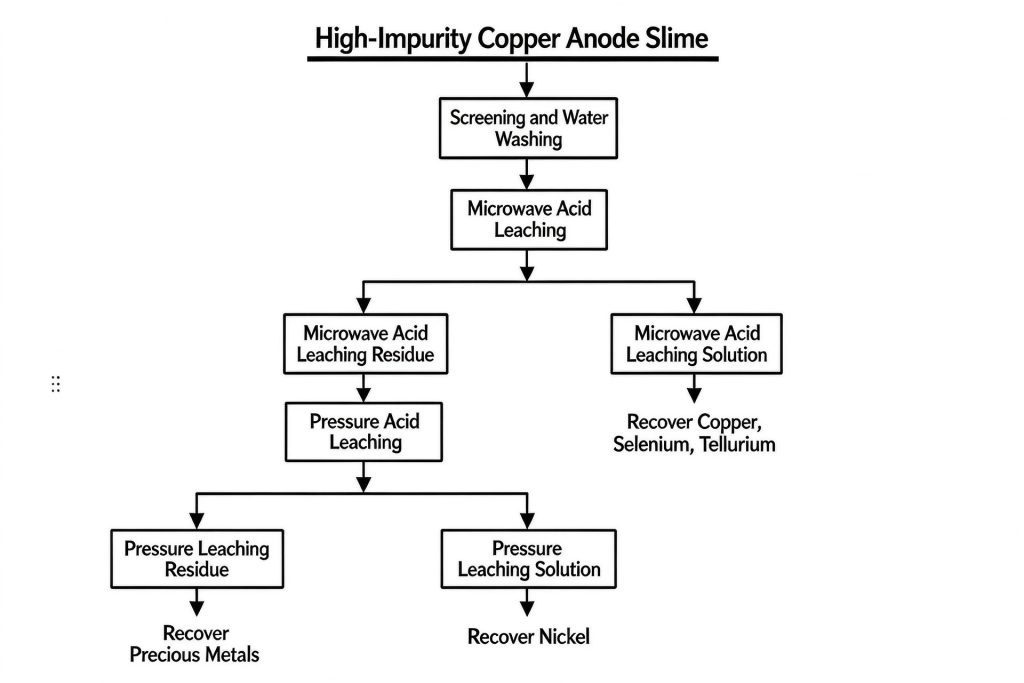
We developed a combined hydrometallurgical pretreatment flow: microwave acid leaching followed by oxygen pressure acid leaching, specially designed for high-impurity copper anode slime. This two-stage process selectively leaches copper, selenium, tellurium and nickel, and concentrates gold and silver into pressure leach residue.
Process Description
Step 1: Microwave Acid Leaching
Raw anode slime is first pulped with water and screened to remove grit particles larger than 5 mm, then dewatered. Sulfuric acid (100~500 g/L) is added for repulping, with solid weight fraction controlled at 5~30%. Oxidant can be compressed air, oxygen-enriched air, industrial pure oxygen or hydrogen peroxide. H₂O₂ dosage ranges from 1 to 5 mol per liter of pulp.
The slurry is treated in a microwave reactor at 2450 MHz, power 300~1000 W, leaching time only 5~30 minutes. Microwave heating delivers internal volumetric heating, generating thermal stress cracks on mineral particles and continuously renewing reaction interfaces. It breaks the passivation shell that often blocks conventional leaching. After solid-liquid separation, leach solution goes for copper, selenium and tellurium recovery, and microwave leach residue proceeds to pressure leaching.
Step 2: Oxygen Pressure Acid Leaching
Microwave leach residue is repulped with dilute sulfuric acid (100~500 g/L), agitated for 0.5~1.5 h, solid concentration kept at 10~30%. The pulp is fed into an autoclave under oxygen pressure 0.8~1.2 MPa, reaction temperature 165~185 ℃, stirring speed 400~1000 rpm, retention time 4~6 h.
High pressure elevates solution temperature above atmospheric boiling point and raises oxygen partial pressure, greatly strengthening the leaching of nickel-bearing oxide phases that microwave leaching cannot remove efficiently. After filtration, pressure leach residue is the high-grade precious metal concentrate for gold and silver extraction; pressure leachate is sent to nickel recovery.
Performance Data
Test campaigns on high-impurity copper anode slime from a southern China copper refinery deliver stable results:
- Copper leaching rate: 96~99%
- Selenium leaching rate: 93~98%
- Tellurium leaching rate: 94~99%
- Nickel leaching rate: 90~94%
- Silver dissolution loss is controlled below 2.4%
- Final enriched residue: Au ~1.3~1.7%, Ag ~12.5~13.8%
Key Advantages
- Fast treatment cycle: Microwave stage finishes within 30 minutes, cutting total residence time compared with roasting or atmospheric leaching lines. Higher daily throughput.
- Good separation selectivity: Base metals Cu / Se / Te / Ni are transferred into liquid streams, while Au and Ag stay in solid residue. Metal distribution is clear and easy for subsequent individual recovery.
- Lower operating cost: Reduced acid and oxidant consumption in downstream precious metal refining; simplified purification flowsheet.
- Flexible oxidant options: Adaptable to onsite gas supply, either compressed air / enriched oxygen or hydrogen peroxide.
- Green hydrometallurgy: Avoids flue gas from roasting processes, convenient for emission control and environmental compliance.
Application
This technology fits copper smelters and precious metal recycling plants that process high-impurity copper anode slime. It can be deployed as a standalone pretreatment section or integrated into existing gold-silver refinery circuits. The leachate and residue streams are well suited for solvent extraction, precipitation and electrowinning to produce saleable selenium, tellurium, nickel cathode and gold-silver doré.