Overview
Electrolytic copper (cathode copper) acts as a fundamental raw material for modern electrical, electronic and metallurgical industries. Produced by copper electro‑refining process, it reaches a minimum purity of 99.99%, featuring superior electrical and thermal conductivity, great ductility and reliable corrosion resistance. Even high‑grade blister copper obtained from fire smelting still contains trace impurities including nickel, arsenic, antimony, bismuth, gold and silver. Electro‑refining effectively separates these impurities and converts semi‑finished blister copper into premium‑grade cathode copper for downstream manufacturing. Our manufacturing adopts proven large‑scale electrolytic tank‑house design, achieving stable mass production, high metal recovery rate and full recovery of valuable metals contained in anode slime.
Core Principle of Copper Electro‑Refining
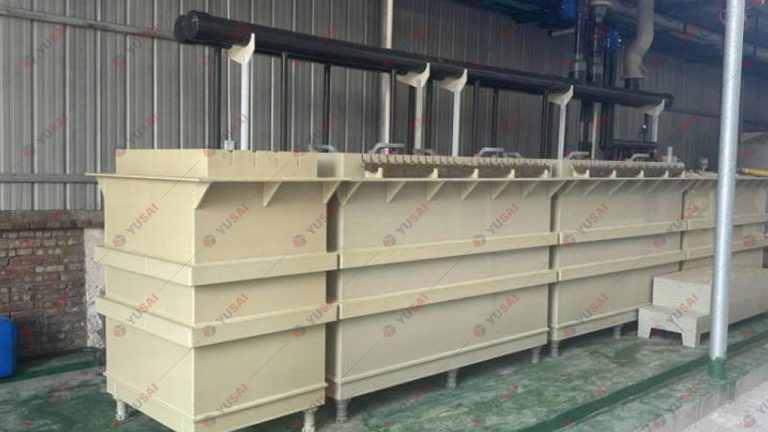
Copper electro‑refining is an electrochemical purification process operated in large reinforced‑concrete electrolytic cells with acid‑resistant inner lining.
- Anode: Fire‑refined blister copper cast into heavy anode plates with copper content between 99.2 % and 99.7 %.
- Cathode: Thin pure‑copper starter sheets or permanent stainless‑steel mother plates.
- Electrolyte: Mixed aqueous solution composed of copper sulfate and sulfuric acid, together with specially developed organic additives.
When direct current flows through electrolytic cells:
- Anode reaction: Impure metallic copper dissolves into copper ions: \(\boldsymbol{Cu – 2e^‑ \rightarrow Cu^{2+}}\). Base‑metal impurities dissolve into electrolyte solution. Precious metals like gold, silver and platinum‑group metals, along with selenium and tellurium, will not dissolve. They settle to cell bottom in the form of anode slime for subsequent precious‑metal extraction.
- Cathode reaction: Pure copper ions gain electrons and deposit compactly on cathode surface: \(\boldsymbol{Cu^{2+}+2e^‑\rightarrow Cu}\). Most harmful impurity ions remain in the electrolyte and will be eliminated through electrolyte purification. Hydrogen precipitation can be well restrained under standard operating conditions.
Additives such as animal glue, thiourea, casein and trace chloride ions control copper crystal growth. They prevent dendrites, nodules and surface defects to produce smooth and dense cathode sheets.
Key Production Process Flow
The complete production workflow covers main electrolytic refining and closed‑loop electrolyte purification.
- Electrolysis stage: Anode plates and cathodes are placed alternately inside electrolytic tanks. Under regulated direct‑current conditions, high‑purity copper continuously deposits onto cathodes. Anode plates dissolve gradually and turn into residual anode scrap which returns to fire‑smelting procedure. The cathode harvesting cycle ranges from 10 to14 days. Anode service life lasts roughly 20‑24 days, with residual‑anode rate kept at 14‑16 %.
- Electrolyte circulation & temperature control: Electrolyte keeps circulating among all tanks. Titanium or graphite heat‑exchangers maintain working temperature at 55‑62 ℃ to accelerate ion diffusion and reduce cell voltage.
- Electrolyte purification: During electrolysis, impurities including arsenic, antimony, bismuth and nickel keep accumulating in circulating electrolyte. Part of spent electrolyte is diverted for purification treatments: copper sulfate crystallization, decoppering electrolysis and crude nickel sulfate crystallization. After impurity removal and acid regeneration, processed solution flows back to electrolytic workshop to realize closed‑cycle reuse.
- Post‑treatment: Finished cathode copper sheets go through stripping, washing, quality inspection and bundling for delivery. Anode slime is collected and transferred for gold‑silver and rare‑element recovery.
Major Technical Operating Parameters (Industrial Tank‑House Reference)
表格
| Item | Typical Working Value |
|---|---|
| Current density | 220‑240 A/m² |
| Cell voltage | 0.25‑0.30 V |
| Electrolyte Cu²⁺ concentration | 40‑50 g/L |
| Sulfuric acid concentration | 170‑210 g/L |
| Operating temperature | 58‑62 ℃ |
| Homopolar center distance | 80‑110 mm |
| Current efficiency | 96‑98 % |
| DC power consumption | 210‑260 kWh per ton cathode copper |
| Copper electrolytic recovery rate | ≥ 99.8 % |
Product Properties & Quality Standard
Our electrolytic copper cathodes meet ASTM B115 and LME Grade‑A standards, with strict limitation on trace harmful elements.
Typical chemical composition:
- Cu ≥ 99.99 %
- Ag ≤ 0.0025 %, As ≤ 0.0005 %, Sb ≤ 0.0004 %, Bi ≤ 0.0001 %, Fe ≤ 0.0010 %, Pb ≤ 0.0005 %
Physical performance:
- Electrical conductivity ≥ 58 MS/m (exceeding 100 % IACS standard)
- Melting point: 1083 ℃
- Superior ductility for wire‑drawing, rolling and alloy smelting
- Smooth, burr‑free sheet surface, suitable for remelting and further processing
Cathode dimensions support customized requirements. Single piece weight normally falls within 80‑150 kg. Goods are pallet‑bundled with moisture‑proof packaging to fit long‑distance ocean transportation.
Main Industrial Applications
Benefiting from outstanding electrical‑thermal performance and corrosion resistance, electrolytic copper serves as critical raw material for multiple global industries:
- Power & electrical industry: Manufacture of power cables, enameled wires, bus‑bars, transformers, switch‑gears and motor windings. This sector accounts for more than half of global copper consumption volume.
- Electronic industry: Copper foil for printed circuit boards, connector terminals, lead frames and semiconductor components.
- Alloy production: Raw feedstock for brass (Cu‑Zn), bronze (Cu‑Sn), cupronickel (Cu‑Ni), applied in valves, hardware, marine fittings and heat‑exchange devices.
- Heat‑exchange equipment: Radiators, condensers, solar thermal collectors and heat‑transfer pipes for seawater desalination.
- Construction & corrosion‑resistant components: Water supply pipelines, roof panels, art casting and coin production.
Advantages of Our Electro‑Refining Technology
- Stable high‑quality output: Closed‑loop monitoring for electrolyte composition, temperature, additives and electric parameters guarantees consistent LME Grade‑A cathode quality across different production batches.
- Full resource utilization: Valuable gold, silver, selenium, tellurium from anode slime and nickel recovered via nickel‑sulfate crystallization maximize overall metal utilization efficiency.
- Energy‑saving equipment setup: High‑efficiency titanium or graphite heat‑exchangers, large‑size silicon rectifier units, automatic cathode‑stripping machines and overhead cranes cut manual workload and production costs.
- Eco‑friendly production: Special ventilation setup reduces acid mist; process liquid achieves internal recycling with limited waste‑liquid discharge. Residual anodes and copper scraps get recycled inside the plant.
- Flexible production capacity: Mature tank‑house design supports large‑scale mass output as well as capacity adjustment responding to various client order needs.
Why Choose Our Electrolytic Copper
We supply certified Grade‑A electrolytic copper cathodes with complete inspection documents for customs clearance. Flexible order quantity, stable monthly supply capacity and full‑set export‑logistics service satisfy purchasing demands from smelters, cable manufacturers, alloy producers and metal traders all over the world.
Please reach out to our sales team if you need detailed technical datasheets, sample evaluation or formal quotation.