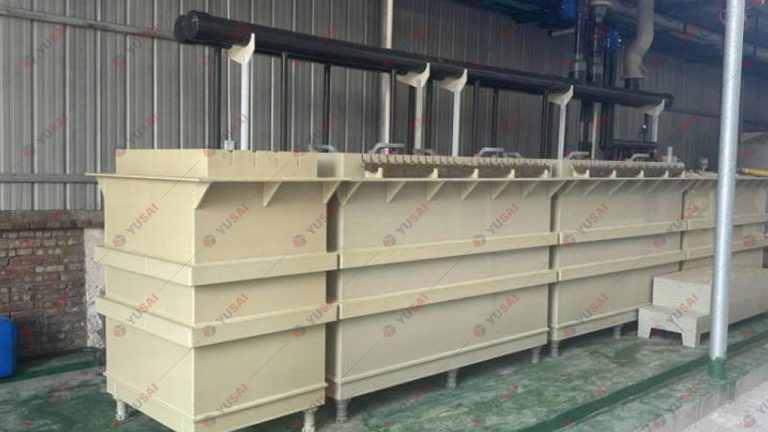
Copper electrolytic refining is the dominant industrial technology to convert fire‑refined crude copper (99.0%‑99.8% Cu) into high‑purity cathode copper (electrolytic copper) for electrical, electronic and metallurgical industries This electrochemical process not only delivers ultra‑pure copper product, but also recovers precious and rare metals including gold, silver, selenium and tellurium as valuable by‑products from anode slime.
Basic Working Principle
Crude copper from pyrometallurgical smelting is cast as anodes, while pure copper starter sheets or permanent stainless steel plates serve as cathodes. Anodes and cathodes are alternately installed inside electrolytic tanks filled with sulfuric acid‑copper sulfate electrolyte. When direct current is applied, electrochemical reactions take place on electrode surfaces.
Anode Reaction (oxidation):
\(\boldsymbol{Cu – 2e^- = Cu^{2+}} \quad E^0(\mathrm{Cu^{2+}/Cu})=+0.34\ \mathrm{V}\) Impure copper dissolves into electrolyte in form of cupric ions. Base metals with more negative potential also dissolve into solution. Noble metals, selenium and tellurium will not dissolve and sink to cell bottom as anode slime.
Cathode Reaction (reduction):
\(\boldsymbol{Cu^{2+}+2e^- = Cu} \quad E^0(\mathrm{Cu^{2+}/Cu})=+0.34\ \mathrm{V}\) Copper ions are preferentially reduced and deposited onto cathode surface to form high‑purity cathode copper. Other soluble base‑metal impurities remain within electrolyte and will be removed in periodic electrolyte purification procedures. Minor side‑reactions generating cuprous ions inevitably exist and add complexity to the whole electrolytic system.
Two mainstream technical routes are applied in modern tankhouses: the traditional starter‑sheet electrolysis process, and permanent stainless‑steel cathode electrolysis technology. Permanent stainless‑steel cathode technique gains wide popularity for multiple operational strengths: higher allowable current density, narrower inter‑polar distance, shorter cathode cycle, superior cathode copper quality, lower anode scrap rate, reduced steam consumption, simplified workflow, high automation level, less manual labor, and lower metal inventory for faster capital turnover. After copper deposition, copper sheets are mechanically stripped directly from reusable stainless‑steel substrate.
Core Operating Technical Conditions
Reasonable control over electrolyte composition, temperature, current density, circulation mode and additives is critical to stable production and qualified cathode quality.
- Current Density Current density refers to electric current per unit effective cathode area. Normal operating range is 220‑270 A/m². Higher current density boosts plant capacity but must match other parameters to avoid dendrite growth and short‑circuit risk.
- Electrolyte Composition Electrolyte is aqueous solution of copper sulfate and sulfuric acid. Typical concentration range: copper 40‑50 g/L, free sulfuric acid 180‑240 g/L. The “high‑acid low‑copper” formula is generally preferred. Excessive accumulation of nickel, iron, arsenic, antimony and bismuth increases electrolyte viscosity and resistance. Floating anode slime triggered by high arsenic‑antimony‑bismuth content will severely contaminate cathode copper. Impurity build‑up requires continuous bleeding‑and‑purification loop.
- Electrolyte Temperature Operating temperature is kept at 55‑65℃. Moderately raised temperature reduces solution viscosity, improves ion diffusion and promotes uniform copper deposition. Excessively high temperature brings higher steam consumption and heavy acid mist, worsening working environment.
- Electrolyte Circulation Mode Circulation homogenizes temperature and chemical composition across the tank and mitigates concentration polarization. Traditional circulation patterns include “inlet‑top outlet‑bottom” and “inlet‑bottom outlet‑top”. Large‑scale modern electrolytic cells adopt full‑width parallel horizontal circulation, whose circulation volume reaches 2‑3 times of conventional modes.
- Additives Organic and inorganic additives are dosed to obtain compact, smooth cathode deposits:
- Gelatine: major additive for dense and bright cathode surface.
- Thiourea: surface‑active agent, works together with gelatine for sound deposit under high current density.
- Casein: restrains particle growth on cathode surface when mixed with gelatine.
- Hydrochloric acid: maintains proper chloride ion concentration inside electrolyte.
- Polar Distance, Anode Service Life & Cathode Cycle Homopolar center‑to‑center distance: 75‑90 mm for small‑size plates; 100‑110 mm for large‑size plates. Anode service life normally lasts 18‑24 days, determined by current density, anode grade and target anode scrap rate. Cathode production cycle is approximately one‑third of anode service cycle. Starter‑sheet cells require stricter parameter control to produce flawless starting cathodes.
Major Technical‑Economic Indicators
These indexes evaluate plant performance, energy and raw‑material consumption for copper electrolytic refining tankhouse.
表格
| Item | Typical Value Range | Explanation |
|---|---|---|
| Current Efficiency | 94%‑98% | Ratio of actual copper cathode output against theoretical yield, affected by short‑circuit, electric leakage and chemical dissolution |
| Anode Scrap Rate | 15%‑18% | Weight percentage of residual anode over total input anode mass |
| Copper Overall Recovery Rate | 99.6%‑99.8% | Comprehensive metal recovery across the whole electrolytic workshop |
| Cell Voltage | 0.2‑0.3 V (normal cell); 0.3‑0.4 V (starter‑sheet cell) | Sum of voltage drop from electrolyte resistance, conductor contacts, anode slime layer and concentration polarization |
| DC Power Consumption | 230‑450 kWh per ton of cathode copper | Total DC power covering electrolytic tanks and line losses |
| Sulfuric Acid Consumption | 4‑10 kg / t cathode copper | Acid make‑up consumption |
| Steam Consumption | 0.1‑1.5 t / t cathode copper | Lower value for tankhouses with thermal insulation measures |
| Water Consumption | 3‑5 m³ / t cathode copper | Process fresh‑water consumption |
Process Summary
Copper electrolytic refining transfers copper from fire‑refined impure anodes to high‑grade cathodes under DC power. Insoluble precious‑metal‑rich anode slime is collected for further by‑product recovery. Soluble impurities are removed through electrolyte purification, generating by‑products such as regenerated copper, crude nickel sulfate and crystallized copper sulfate. With mature process options between traditional starter‑sheet route and advanced permanent stainless‑steel cathode technology, operators can select suitable solutions based on capacity target, investment budget and local labor conditions. Strict monitoring on technical parameters guarantees stable cathode copper quality and optimizes energy & reagent cost for metallurgical projects.