Copper from fire refining normally reaches 99.2%–99.7% grade, still containing 0.3%–0.8% impurities. Electrorefining is required to produce high-purity cathode copper that meets industrial specifications, while recovering valuable by-products including gold, silver, platinum-group metals, selenium, tellurium and scattered rare metals from anode slime.
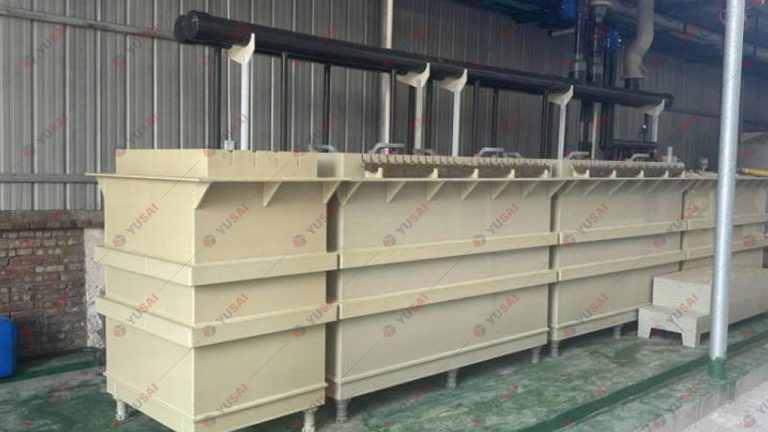
Copper electrorefining uses cast copper anodes, cathode substrates and sulfuric acid-copper sulfate electrolyte. Anodes and cathodes are arranged alternately in electrolytic cells with fixed inter-electrode spacing. Under DC power supply, copper dissolves from the anode and deposits onto the cathode surface as pure electrolytic copper. Precious metals, selenium and tellurium settle as anode slime at the cell bottom and are collected periodically for precious metal extraction. Impurities such as nickel, arsenic, antimony and bismuth mostly dissolve into the circulating electrolyte. A side stream of electrolyte is continuously bled out for purification to stabilize the electrolyte composition. The full circuit covers two core sections: electrorefining and electrolyte purification.
Three mainstream industrial routes are available for copper electrorefining: conventional electrorefining, periodic reverse current electrorefining and permanent cathode (ISA) electrorefining.
1. Conventional Electrorefining
Conventional electrorefining adopts pure copper starter sheets as cathodes and steady DC power, operating at current density of 220–280 A/m². This mature technology has decades of global operational history with stable performance and low power consumption. Modern automation units for anode/cathode preparation and straightening further reduce short-circuit risk and lift cathode copper quality.
However, the starter sheet system brings obvious drawbacks. It requires an independent production line and heavy manual workload. Two inherent limitations restrict its output:
- The process has a limiting current density. Operating above this threshold causes rough copper deposits and dendritic growth, triggering frequent short circuits, soaring power use and unstable cathode quality.
- Anode passivation easily occurs. Under normal cell voltage, the anode stops dissolving. Operators must raise voltage to break the passive film, which wastes electricity and leads to inconsistent cathode composition and physical properties.
2. Periodic Reverse Current Electrorefining
This technology applies short, periodic current reversal on the same anode and cathode setup as conventional refining. Current reversal suppresses anode passivation, allowing higher current density of 300–350 A/m². It boosts tankhouse throughput, cuts capital expenditure and shortens production cycle.
Its main disadvantage is lower current efficiency and higher specific power consumption. It is widely recommended for existing refinery expansion and sites with low electricity cost.
3. Permanent Cathode Electrorefining (ISA Process)
The ISA process, or permanent stainless steel cathode process, was first commercialized in Australia in 1979 and later adopted by refineries across North America and Europe. Unlike starter sheet routes, it uses reusable stainless steel blank cathodes. After copper fully deposits on the stainless steel surface, the copper plate is mechanically stripped as finished cathode copper, and the clean stainless blank returns to the cell for the next cycle.
Key advantages of ISA technology:
- Eliminate the whole copper starter sheet workshop and related labour cost
- Ultra-flat stainless cathode substrate minimizes short-circuit events
- Consistent, smooth cathode surface with superior purity and appearance
For this project design, the ISA permanent cathode electrorefining process is selected as the preferred technical solution.
Electrochemical Fundamentals of Copper Electrorefining
Anode Reactions
The anode undergoes oxidation. Copper is the primary active component and dissolves into the electrolyte as cupric ions (Cu²⁺). Metals with more negative potential than copper, including iron, nickel, lead, arsenic and antimony, preferentially dissolve into the electrolyte. Due to their low concentration in anode copper, their electrode potential drops further and keeps them in the liquid phase.
Water and sulfate ions have much more positive oxidation potential, so they will not be oxidized under normal refining voltage. Noble metals such as gold, silver and platinum-group metals are electrochemically inert; they do not dissolve and fall into anode slime.
Cathode Reactions
Reduction takes place on the cathode surface. Hydrogen has a much more negative standard potential, plus high hydrogen overpotential on copper. Therefore, hydrogen evolution is negligible under standard operating conditions, and only Cu²⁺ is reduced to metallic copper. Base metals with negative potential will not plate out on the cathode.
Cuprous ions (Cu⁺) form in the electrolyte and reach dynamic equilibrium. Although equilibrium Cu⁺ concentration stays low, side reactions consume sulfuric acid, increase soluble Cu²⁺ and produce fine copper powder. Copper powder mixes into anode slime and dilutes precious metal grades. Chemical copper dissolution also occurs at the electrode-electrolyte boundary.
Impurity Behaviours on Copper Anodes
Impurities in cast copper anodes fall into three categories according to their electrolytic behaviour:
- Noble metals and stable compound-forming elements Gold, silver and platinum-group metals do not dissolve and report to anode slime. Silver sulfate is slightly soluble, but trace chloride addition precipitates silver chloride into slime. Oxygen, sulfur, selenium and tellurium exist as stable copper-selenium, copper-telluride and copper sulfide phases and enter anode slime directly.
- Electronegative impurities: nickel, iron, zinc, lead, tin Fire refining removes most iron and zinc; their content in anode copper is usually only 0.001%–0.003%. Dissolved Fe²⁺ partially oxidizes to Fe³⁺, which circulates between anode and cathode and reduces overall current efficiency. Dissolved iron and zinc consume sulfuric acid, raise electrolyte viscosity and resistance. Lead dissolves and quickly forms insoluble lead sulfate precipitate. Tin dissolves as Sn²⁺, oxidizes to Sn⁴⁺, then hydrolyses into basic tin salts and settles into slime.
Anode oxygen content strongly affects nickel distribution. Low oxygen anodes release most nickel into electrolyte; high oxygen anodes form insoluble nickel compounds, so a large fraction of nickel goes to anode slime.
- Co-potential impurities: arsenic, antimony, bismuth These elements may co-deposit on cathodes and degrade copper quality. They also form fine floating arsenate precipitates (SbAsO₄, BiAsO₄). These suspended particles mechanically stick to cathode copper. Antimony causes more severe contamination than arsenic.
Electrolyte Purification Process
Continuous anode dissolution gradually accumulates copper and base impurities while depleting free sulfuric acid and enriching organic additives. Refineries continuously bleed a fixed volume of electrolyte and replenish fresh make-up solution to lock electrolyte composition within target ranges. Purification targets: recover copper, nickel and cobalt, remove harmful arsenic, antimony and bismuth, and regenerate reusable sulfuric acid. The purification circuit includes three main stages.
1. Neutralization & Copper Sulfate Crystallization
Copper powder neutralizes excess sulfuric acid in bleed electrolyte to produce copper sulfate. Neutralization can run batch-wise in stirred tanks or continuously in bubble columns. The solution is evaporated and concentrated to saturated copper sulfate solution at 80–90 °C. Cooling triggers crystallization of blue vitriol (CuSO₄·5H₂O). Continuous water-cooled belt crystallizers or batch stirred crystallizers are commonly used.
2. Decoppering & Removal of Arsenic, Antimony, Bismuth
Mother liquor after copper sulfate crystallization feeds into electrowinning cells with inert anodes. Black copper powder deposits, and sulfuric acid is regenerated. When Cu²⁺ concentration drops below 8 g/L, arsenic, antimony and bismuth co-precipitate with copper to form arsenic-bearing black copper, accompanied by hydrogen evolution. Black copper is returned to the fire refining circuit.
3. Crude Nickel Sulfate Production
Decopperized liquor contains roughly 40–50 g/L nickel and ~300 g/L free sulfuric acid. It is evaporated to reach nickel sulfate saturation and cooled for crystallization separation. Filtrate after nickel crystallization holds 7–10 g/L Ni and ~400 g/L H₂SO₄. If arsenic and antimony levels are low, the acid stream can be filtered, heated and returned directly to the electrorefining tankhouse. If heavy impurities remain, further evaporation precipitates anhydrous sulfate salts before acid recycling.
Two nickel crystallization routes are available:
- Evaporative crystallization: higher nickel removal rate, but high acid loss and tough working conditions; preferred for small-scale plants.
- Refrigeration crystallization: zero waste gas emission, higher capital investment; suitable for large modern refineries.
Conclusion
ISA permanent cathode electrorefining delivers stable high-grade cathode copper, less downtime, simplified operation and lower labour intensity compared with conventional starter sheet and periodic reverse current processes. Combined with the mature bleed purification circuit for copper sulfate, black copper and nickel sulfate recovery, the whole process maximizes metal recovery, controls hazardous impurities and realizes closed-loop sulfuric acid circulation. It is a reliable, cost-effective technical solution for new copper electrorefining projects.