Introduction
Copper is one of mankind’s earliest‑utilized metals, featuring excellent electrical conductivity, thermal conductivity, ductility and corrosion resistance. It serves as the core raw material for power transmission, cables, electronic components, new‑energy equipment, plumbing hardware and industrial manufacturingCopper Dev….
Copper ore smelting via pyrometallurgy produces blister copper (crude copper, 99.2‑99.7 % Cu). Even trace impurities will raise electrical resistance and degrade mechanical performance. To obtain LME‑grade A cathode copper (≥99.99 % Cu) for industrial use, electro‑refining is adopted as the final purification step.
Electro‑refining transfers copper from impure anodes onto cathodes under direct‑current power. Meanwhile, valuable precious metals and harmful impurities are separated. Besides producing high‑purity copper, the process also recovers gold, silver, selenium, tellurium and nickel from by‑products, bringing considerable economic benefits.
Fundamental Electrochemical Principle
The electrolytic cell uses blister‑copper cast plates as anodes, high‑purity copper starter sheets or permanent stainless‑steel plates as cathodes, and acidic copper‑sulfate solution as electrolyte. The electrolyte normally contains 40‑55 g/L Cu and 150‑220 g/L free sulfuric acid, operating at 58‑62 ℃ in commercial production.
Main Electrode Reactions
Anode (oxidation, impure copper dissolves):
\(\boldsymbol{Cu(s) – 2e^- \rightarrow Cu^{2+}(aq)}\)
Impurity metals with lower electrode potential (Fe, Ni, Zn) also dissolve into solution:
\(Me(s)-2e^- \rightarrow Me^{2+}(aq)\)
Noble metals (Au, Ag, Pt‑group metals) possess higher potential than copper. They will not dissolve electrochemically and fall off as solid particles, forming anode slime at the tank bottom.
Cathode (reduction, pure copper deposits):
\(\boldsymbol{Cu^{2+}(aq)+2e^- \rightarrow Cu(s)}\)
Under normal operating voltage, hydrogen and base‑metal ions such as Ni²⁺, Fe²⁺ will not be reduced onto cathode plates. Only copper ions preferentially precipitate, realizing metal purification科普中国.
Overall cell total reaction:
\(\boldsymbol{Cu(impure)\xrightarrow{DC}Cu(pure)}\)
Note: No net consumption of copper sulfate in the ideal steady‑state cell; copper is simply “transported” from anode to cathode. Real‑world production needs continuous electrolyte purification to control accumulating impurities.
Three Categories of Anode Impurity Behaviors
- Noble metals & stable compounds (Au, Ag, Se, Te): Do not dissolve, settle into anode slime. Anode slime is sent to auxiliary workshops for precious‑metal recovery, an important profit source for refineries.
- Base‑metal impurities (Ni, Fe, Zn): Dissolve into electrolyte. They keep accumulating in circulating solution and must be removed by solution‑purification processes; otherwise, they increase solution viscosity and resistance, raising power consumption.
- Arsenic, antimony, bismuth: Part dissolve into solution, partly form fine suspended arsenate precipitates. Floating particles may mechanically attach to cathode surfaces and downgrade copper quality, which is one of the key control challenges in copper refineries.

Main Industrial Process Routes
There are three mainstream electro‑refining technologies in global copper tankhouses: conventional starter‑sheet electrolysis, periodic reverse‑current electrolysis, and ISA permanent‑stainless‑steel‑cathode electrolysis (ISA Process).
1. Conventional Starter‑Sheet Electrolysis
Thin pure‑copper starter sheets act as cathodes, with constant direct current. Typical current density: 220‑280 A/m². Advantages: mature technology, low power consumption. Drawbacks: complicated starter‑sheet manufacturing procedure; starter sheets are easy to deform, raising short‑circuit risk and limiting maximum current density.
2. Periodic Reverse‑Current Electrolysis
Short‑time periodic reversal of current direction suppresses anode passivation, allowing higher current density (300‑350 A/m²) and boosting output. Drawbacks: reduced current efficiency and higher power consumption; suitable for plant expansion under low‑electricity‑cost conditions.
3. ISA Permanent‑Cathode Electrolysis (Modern Preferred Technology)
First industrialized in Australia in 1979. Instead of fragile copper starter sheets, 316L stainless‑steel plates serve as permanent cathodes. High‑purity copper deposits on stainless‑steel substrates; after the production cycle, mechanical stripping machines peel finished cathode copper off the plates, and the stainless‑steel blanks return to electrolytic cells for repeated use.
Core advantages:
- Cancel the whole starter‑sheet production line, simplify workflow and lower labor intensity;
- Stainless‑steel plates have excellent flatness and verticality, greatly reducing short‑circuit faults;
- Enable higher current‑density operation, improve single‑tank production capacity;
- Stable cathode surface morphology, consistently produce high‑quality LME Grade‑A copper cathodes.
This article takes ISA permanent‑cathode process as the reference technical route.
Key Operating Parameters for Copper Electro‑Refining
Process parameters jointly determine cathode quality, current efficiency and energy consumption. Typical industrial values are listed below:
表格
| Parameter | Typical Industrial Range |
|---|---|
| Electrolyte copper content | 40‑55 g/L |
| Free sulfuric acid | 150‑220 g/L |
| Working temperature | 58‑62 ℃ (up to 63‑65 ℃ for high‑current‑density operation) |
| Current density | 220‑300 A/m² |
| Centre‑to‑centre inter‑polar distance | 80‑110 mm |
| Cell voltage | 0.2‑0.3 V |
| Current efficiency | ~96 % |
| Anode service life | 18‑21 days |
| Cathode stripping cycle | ~7 days |
Function of Additives
Small‑dose additives are essential to obtain dense, smooth cathode copper:
- Animal glue: refines copper grain structure, improves deposit surface quality;
- Thiourea: cooperates with glue to further smooth cathode surfaces;
- Hydrochloric acid (chloride ions): precipitates silver‑ion impurities, suppresses anode passivation and dendrite growth. Excess chloride will cause harmful needle‑shaped copper deposits.
Electrolyte Purification: Guarantee for Long‑Term Stable Production
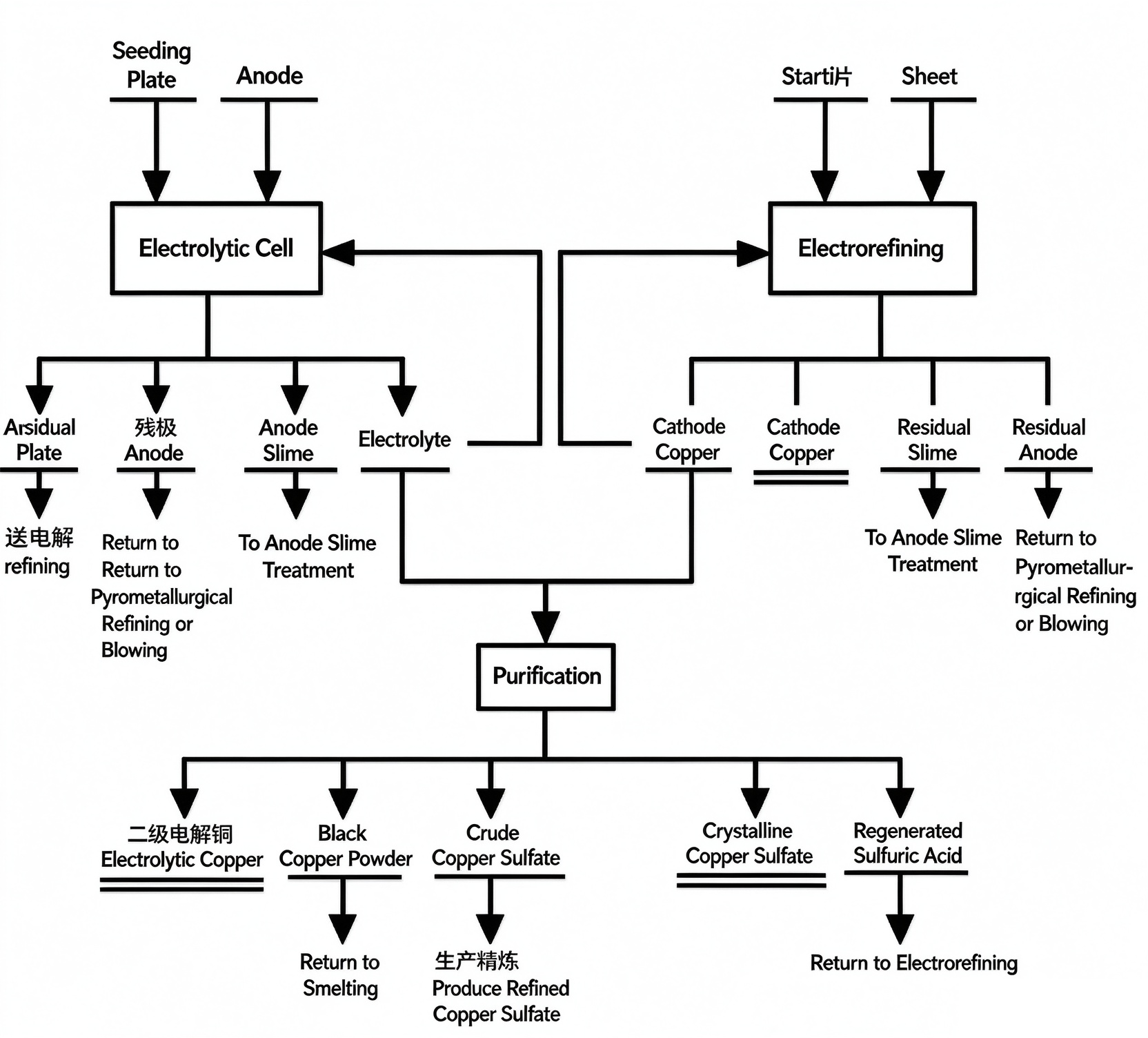
As electrolysis proceeds, nickel, arsenic, antimony, bismuth continuously dissolve and build‑up inside circulating electrolyte. If impurity concentrations exceed safe thresholds, cathode quality will deteriorate sharply. Therefore, a fraction of electrolyte must be continuously diverted to the purification section, and purified solution returns to electrolytic tanks.
Major purification steps:
- Copper sulfate crystallization: Recover copper as copper sulfate crystal by evaporation‑cooling;
- First‑stage decoppering: Electrowinning removes most residual copper;
- Second‑stage decoppering: Remove arsenic, antimony, bismuth, produce black‑copper by‑product sent back to pyrometallurgy;
- Nickel‑sulfate crystallization: Recycle nickel as crude nickel‑sulfate product;
- Purified sulfuric‑acid‑rich solution flows back to the electro‑refining tankhouse.
Main Equipment in Copper Refining Tankhouse
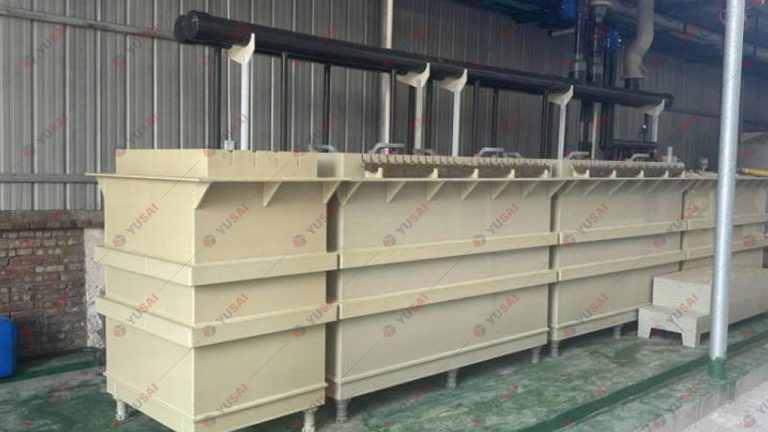
- Electrolytic cells: Mostly monolithic prefabricated reinforced‑concrete tanks lined with PVC or lead‑antimony alloy for acid‑corrosion resistance. Tank bottom slopes for convenient anode‑slime discharge.
- Anode plates: Cast blister‑copper anodes, dimension roughly 940 × 920 mm, weight about 300 kg each. After dissolution, residual anodes (residual rate ~12‑16 %) are sent back for remelting and casting.
- Permanent stainless‑steel cathodes: 316L stainless‑steel plates, matched with automatic stripping machines.
- DC rectifier system: Supplies high‑current low‑voltage direct current for electrolytic cells.
- Electrolyte circulation system: Including circulation pumps, overhead tanks, heaters and piping, maintaining uniform temperature and composition across every cell.
- Auxiliary facilities: Overhead cranes for electrode handling, anode‑slime collection tanks, intermediate storage tanks for purification sections.
Economic‑Technical Indicators
- Residual‑anode rate: 12‑16 %. Too‑low residual anodes risk fragment dropping and tank‑lining damage; high residual rate increases remelting load.
- DC power consumption: Approximately 220‑300 kWh per ton of cathode copper.
- Copper electro‑refining recovery rate: About 99.8 %.
- Anode‑slime yield: Around 0.3‑0.4 % relative to dissolved‑anode weight, rich in precious metals.
Application & Market Background
Cathode copper (electrolytic copper) is the fundamental feedstock for copper processing: drawing into wires and cables, extruding copper tubes, rolling copper sheets and foils for new‑energy batteries, motors, household appliances and infrastructure.
Global copper demand keeps rising. China is the world’s largest copper‑consumer market. Domestic copper‑refineries widely adopt modern permanent‑cathode electrolysis technology, continuously expanding production capacity while improving energy‑saving and environmental‑protection performance. Meanwhile, anode‑slime comprehensive recovery greatly raises resource‑utilization efficiency of copper metallurgy chains.
Environmental & Safety Notes
Copper electro‑refining uses strong‑sulfuric‑acid electrolyte, generating acid mist during high‑temperature operation. Factories must install exhaust‑gas collection and acid‑mist‑removal systems. Waste liquid is strictly treated via purification sections, and heavy‑metal‑containing residues are comprehensively recycled to avoid environmental discharge.
Conclusion
Copper electro‑refining separates impurities relying on differences in metal electrochemical potential. Starting from crude blister copper, the process produces high‑purity 99.99 % cathode copper, while recovering precious‑metal by‑products from anode slime. Modern ISA permanent‑cathode technology improves automation level, product quality and production intensity, and has become mainstream for newly‑built large‑scale copper refineries. Strict control over electrolyte composition, temperature, current density and additive dosage is the core to stable, high‑efficiency and low‑energy‑consumption operation of copper tankhouses.